


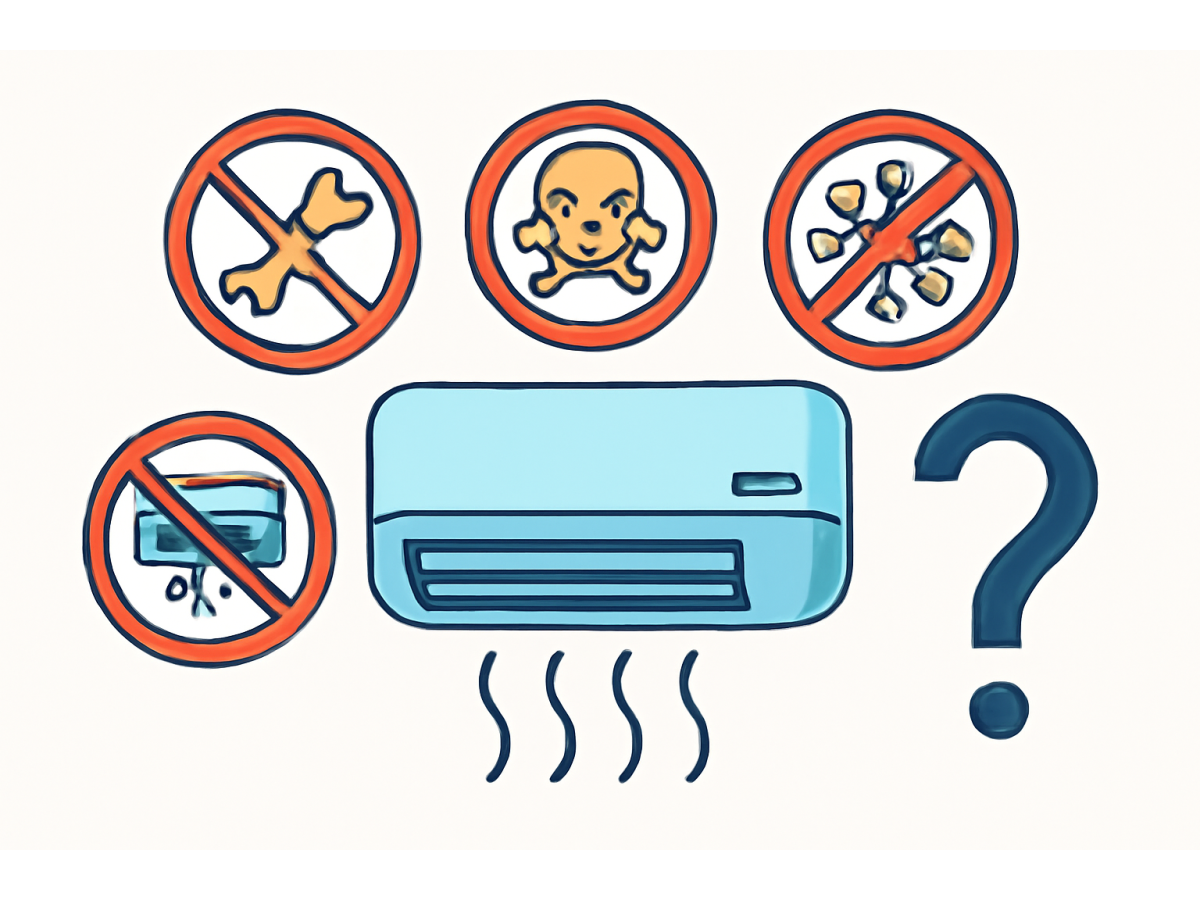
Air-conditioning refrigerant transfers heat through a closed circuit. It is not fuel that the equipment consumes during normal operation. Misunderstanding this distinction can lead to unnecessary recharging, overlooked faults or the purchase of a refrigerant that the system cannot use.
Here are five common myths about refrigerants, with practical explanations of leakage, compatibility, safety and heating operation.
Myth 1: An air conditioner needs refrigerant every year
Fact: a correctly charged, leak-tight system does not need refrigerant added simply because another season has passed. Scheduled maintenance remains necessary, but it is not the same as an automatic annual recharge.
If a technician confirms an insufficient charge, the cause must be established. Possibilities include leakage, an incorrect initial charge or failure to allow for pipe length during installation. These situations require different corrective work.
When a leak is found, it must be repaired before the system's operating charge is restored. Repeatedly adding refrigerant to a leaking circuit does not repair the fault and allows further emissions.
- Confirm the charge-related problem and locate the leak.
- Repair or replace the leaking component, recovering refrigerant as required by the repair procedure.
- Verify tightness and carry out evacuation and other preparation required by the manufacturer.
- Restore the specified charge, check operation and document the work.
For F-gas equipment in the EU, Regulation (EU) 2024/573 requires detected leaks to be repaired without undue delay. Statutory leak checks and any required follow-up checks are separate obligations; their applicability depends on the equipment and refrigerant charge.
Myth 2: All refrigerants are interchangeable
Fact: the correct refrigerant is specified for the particular equipment. Similar names, overlapping applications or a lower price do not establish compatibility.
R410A and R32 have different compositions and safety classifications. The fact that R32 is a component of R410A does not make pure R32 a refill substitute for that blend. Compressors, lubricants, controls, service tools and installation requirements must suit the approved refrigerant.
Do not mix refrigerants or convert a system based on a generic list of alternatives. A conversion requires explicit approval for the equipment concerned and a documented procedure. The same principle applies to vehicles, as explained in our guide to choosing the correct refrigerant for car air conditioning.
Myth 3: Modern refrigerants are harmless and environmentally neutral
Fact: ozone depletion, climate impact and safety are different issues. R410A and R32 have zero ozone depletion potential, but both are greenhouse gases.
- R410A: GWP of approximately 2088 and safety class A1.
- R32: GWP of 675 and safety class A2L.
These are 100-year GWP values on the IPCC AR4 basis. R32 has a lower GWP than R410A, but this does not mean zero climate impact or guaranteed electricity savings.
In the safety classification, A indicates lower toxicity under the standard's criteria. Class 1 means no flame propagation in the specified test conditions; 2L indicates lower flammability with a low burning velocity. Neither classification means the refrigerant can be handled without precautions.
Risks include pressurised releases, frostbite from liquid contact, oxygen displacement and harmful decomposition products under strong heating. For A2L refrigerants, flammability must also be addressed. Follow the safety data sheet and equipment instructions, and use appropriately qualified personnel. In the EU, compliance also depends on the equipment category, application and relevant dates, not just the refrigerant's name.
Myth 4: Poor cooling always means the system needs more refrigerant
Fact: reduced performance is a symptom, not a diagnosis. Several different faults can produce similar complaints.
| Observation | What may need checking |
|---|---|
| Weak airflow | Filters, fan operation, blocked air paths and the condition of the indoor heat exchanger. |
| Airflow is present, but the room stays warm | Operating mode, temperature settings, room heat load, outdoor heat rejection and refrigerant-circuit performance. |
| Ice on the indoor coil or pipework during cooling | Airflow, controls, expansion-device operation and refrigerant charge. Ice alone does not identify a leak. |
| Water dripping from the indoor unit | Condensate drainage, installation and possible thawing of ice. Dripping water is not proof of refrigerant leakage. |
The owner can check settings and clean accessible filters as instructed in the user manual. Refrigerant-circuit measurements and repairs belong to a qualified technician. A single pressure reading cannot establish the correct charge, and adding extra refrigerant can create an overcharge. If leakage is confirmed, repair must come before restoring the charge.
Myth 5: Refrigerant is only used for cooling
Fact: refrigerant also carries heat in heat pumps. In a reversible air conditioner, the same circuit can provide cooling in summer and heating in colder weather.
- Cooling mode: refrigerant absorbs heat at the indoor heat exchanger and releases it outdoors.
- Heating mode: it absorbs heat from outdoor air and releases it at the indoor heat exchanger.
A reversing valve changes the refrigerant flow so the heat exchangers exchange roles. Switching between the unit's normal heating and cooling modes does not require a different refrigerant or seasonal recharging. A cooling-only unit cannot gain heat-pump operation simply by changing its refrigerant.
Heating below 0°C is possible in suitable models, within their specified operating range. Available heating capacity and electricity consumption depend on outdoor conditions and equipment design. In cold, humid weather, the outdoor coil may frost up and require an automatic defrost cycle. A temporary heating interruption and visible water vapour can be normal during defrost; persistent ice accumulation or failure to resume heating requires investigation.
Heating COP expresses the ratio of heat output to electrical power input at specified conditions. SCOP describes seasonal heating performance under defined conditions. Neither figure can be predicted from the refrigerant alone. Our article on assessing business heating and cooling costs explains how to approach an energy comparison.
What to verify before ordering refrigerant
Start with the equipment label and the technician's findings. Confirm the refrigerant designation, required quantity and whether any identified leakage has been repaired. The manufacturer's charge specification, including applicable pipe-length corrections, determines the system quantity.
For equipment approved for these refrigerants, the catalogue includes R410A 10 kg and R32 9 kg. These supply quantities are not universal system charges, and the two products are not interchangeable.
Before purchase, check the product specification, safety data sheet, batch identification and applicable buyer requirements. Confirm current availability, container terms and delivery arrangements for the actual order. Buying the correct refrigerant supports a properly planned service; it does not replace diagnosis or leak repair.
Write a comment