


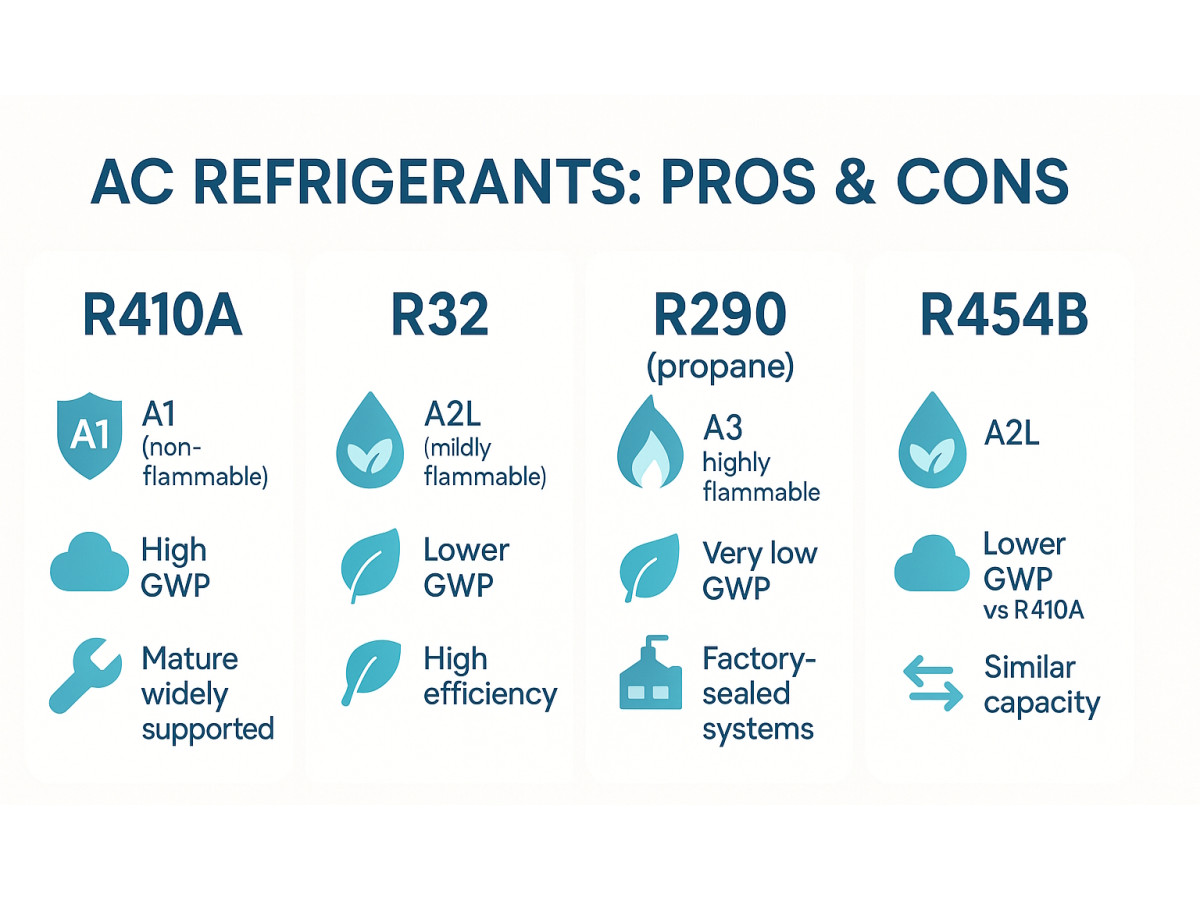
There is no single best refrigerant for every air conditioner. For an existing appliance, use its approved specification. For a new installation, compare complete equipment models: capacity, seasonal efficiency, installation requirements, servicing and applicable restrictions. A ranking based only on the gas name leaves out most of the decision.
Climate impact and safety: a practical comparison
| Refrigerant | Composition | Safety class | GWP100 |
|---|---|---|---|
| R410A | R32/R125 blend | A1 | 2088, rounded |
| R32 | Single-component HFC | A2L | 675 |
| R290 | Propane | A3 | 0.02 |
| R454B | R32/R1234yf blend | A2L | 466, rounded |
The GWP values follow the substances and calculation approach in Regulation (EU) 2024/573; the propane value is listed in Annex VI. Other assessment editions may give different figures. GWP compares the warming effect of emissions over a defined period, not electricity consumption. See our guide to GWP and its use in refrigerant selection.
Class A denotes lower toxicity, not complete harmlessness. Class 1 means no flame propagation under specified test conditions; A2L refrigerants have lower flammability and low burning velocity; A3 refrigerants have higher flammability. None of these labels removes the hazards of pressure, oxygen displacement or cold liquid contact.
R410A: relevant to existing approved equipment
R410A is used in a substantial installed base of air conditioners and heat pumps. Its A1 classification and established service procedures are practical characteristics, but its high GWP is a major limitation. EU restrictions depend on equipment category, activity and date; permission to service an existing appliance is not the same as permission to place a new model on the market.
For an existing R410A machine, assess its condition and applicable service rules. Changing the charge to another gas is not a routine method of extending its regulatory or technical life.
R32: lower GWP with A2L requirements
R32 has a lower GWP than R410A and is used in equipment designed for it. Its single-component composition simplifies some composition-related questions, but does not eliminate charging accuracy, leak repair or safety requirements.
Installation location, permitted charge, room conditions and service equipment must match the particular model. A lower charge or better efficiency may be achieved by a specific design; neither is guaranteed solely by choosing R32.
R290: very low GWP across several equipment designs
Propane is used in approved portable air conditioners, heat pumps and other cooling equipment. Its applications are not defined by one layout alone. Whether a product is a monobloc or another configuration is only part of the assessment.
A3 flammability requires suitable design, charge limits, location and servicing provisions. Do not fill an R410A or R32 appliance with propane. A factory-built product is suitable only when its installation and use also meet its instructions.
R454B: an option for specifically designed new models
R454B contains R32 and R1234yf and has a lower GWP than R410A or R32 on the basis shown. It is used in approved air-conditioning and heat-pump designs, but its A2L classification and blend-specific service procedures must be considered.
It is not a drop-in replacement for installed R410A equipment. A GWP below 750 also does not mean automatic compliance with every present or future equipment restriction. Our article on mixing R410A and R32 explains why shared components do not establish interchangeability.
Compare the equipment, then specify the refrigerant
Where applicable, compare SEER for seasonal cooling and SCOP for seasonal heating, using the same capacity range and climate conditions. Also check operating limits, noise, installation constraints and service availability. These data are more useful than an unsupported claim that one gas always saves a fixed percentage of electricity.
For confirmed service requirements, the pages for R32, 9 kg and R410A, 10 kg provide product options to check against the approved specification. A qualified service company should confirm the product, quantity and lawful use before purchase.
Write a comment