


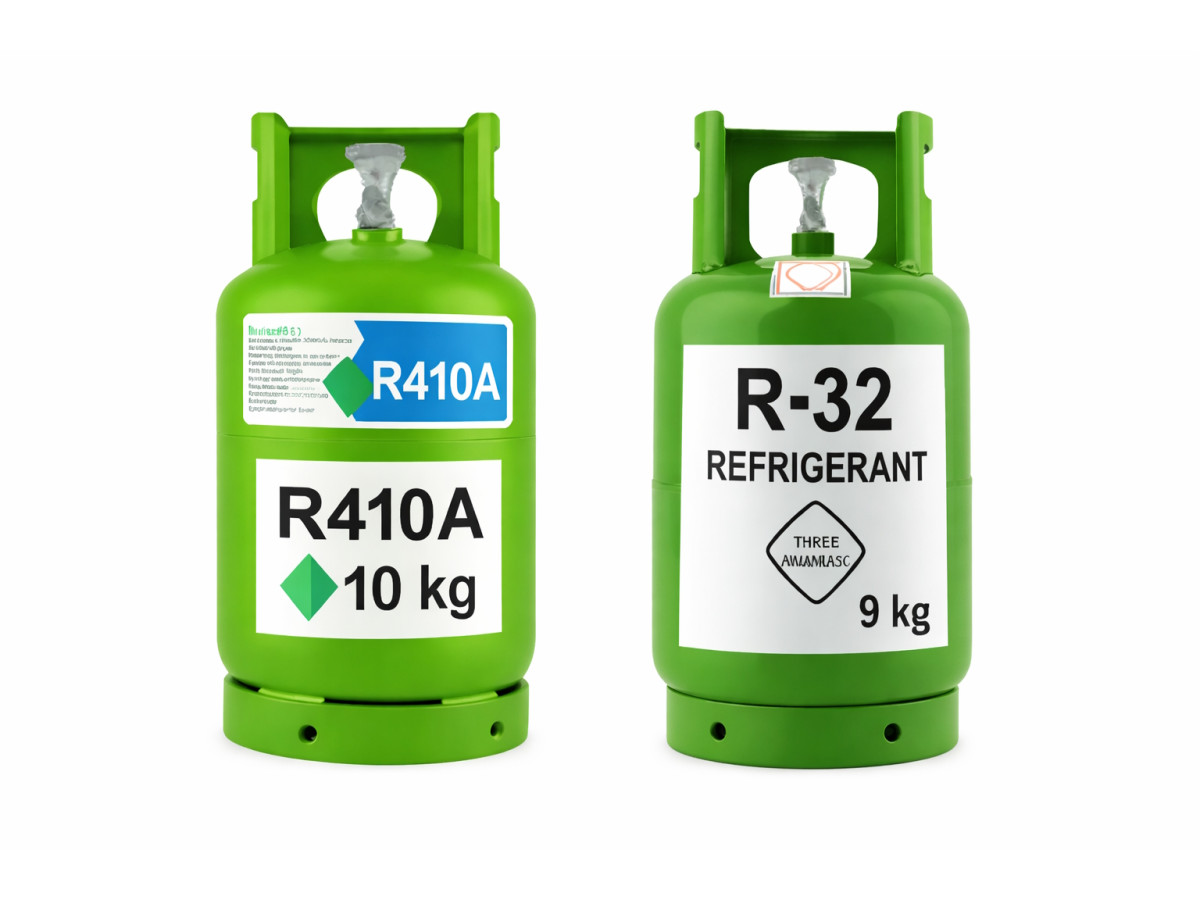
Do not mix R410A and R32 when charging or servicing equipment. R32 is a component of R410A, but adding pure R32 changes the specified blend. It does not restore an R410A charge or convert the appliance into an R32 model.
How the two refrigerants differ
| Property | R410A | R32 |
|---|---|---|
| Composition | 50% R32 and 50% R125 by mass | Single-component refrigerant |
| Safety class | A1 | A2L |
| 100-year GWP, IPCC AR4 basis | 2088, rounded | 675 |
In these safety classes, A denotes lower toxicity, not absolute harmlessness. Class 1 indicates no flame propagation under the specified test conditions; 2L indicates lower flammability with a low burning velocity. Both refrigerants require appropriate precautions for pressurised gas.
Why a shared component does not make them interchangeable
R410A is supplied with a defined composition. Adding R32 alters that composition, so the charge can no longer be assumed to have the published properties of R410A. Pressure-temperature relationships, refrigerant flow and compressor operating conditions may change.
The resulting behaviour depends on the proportions, charge quantity and equipment design. A mixed charge does not inevitably cause an immediate compressor failure or a particular pressure increase. Nevertheless, it falls outside the specified refrigerant composition, making normal service assumptions unreliable.
Nor can the altered mixture automatically retain R410A's A1 classification. Its safety properties cannot be inferred simply from the name on the original cylinder. This is one reason why refrigerant blending belongs in controlled production with verified specifications, not in field servicing.
Can an R410A unit be converted to R32?
R32 is not a drop-in replacement for R410A. The compressor, controls, heat exchangers, charge limits and provisions for flammability all require assessment. Even if two models use oils from the same family, that does not establish conversion approval.
Use only a documented, technically approved conversion procedure where one exists and is legally applicable. Without it, replacing the gas is not an acceptable conversion. Our guide to using an incorrect refrigerant explains the wider compatibility issues.
What if the refrigerants have already been mixed?
- Stop using the affected appliance and contact a qualified service company.
- Provide the refrigerant names, estimated amounts and details of the previous work. Do not try to correct the mixture by adding more gas.
- Have the technician assess the charge and recover it using suitable equipment into an appropriate, clearly identified container, separate from uncontaminated stocks.
- Agree the necessary system treatment and any repairs, then verify tightness and restore the approved charge using the manufacturer's procedure.
The recovered material needs an appropriate recovery, reclamation or disposal route. It must not be vented or returned to a cylinder of saleable refrigerant. A normal-looking pressure reading does not prove the correct composition.
Does lower GWP mean lower electricity consumption?
No. GWP compares the climate effect of emissions; it does not measure a machine's efficiency. An R32 appliance may perform differently from an R410A model, but any energy comparison needs comparable capacity, test conditions and seasonal performance data. Read more in our explanation of GWP and refrigerant selection.
EU F-gas legislation governs matters including emissions, recovery, qualifications and restrictions on use. It should not be summarised as a single blanket clause banning every kind of refrigerant blending. The servicing decision here follows the equipment specification and the absence of approval for an improvised mixed charge.
What should be ordered for a repair?
Once the service company has confirmed the specification, use the relevant page for R410A, 10 kg or R32, 9 kg. Confirm purchasing requirements and cylinder conditions before ordering.
If the existing charge is the correct refrigerant and a leak has been repaired, the technician should follow the manufacturer's instructions on restoring it. Complete replacement is not automatically necessary after every leak, but adding a different refrigerant is not an acceptable shortcut.
Write a comment