


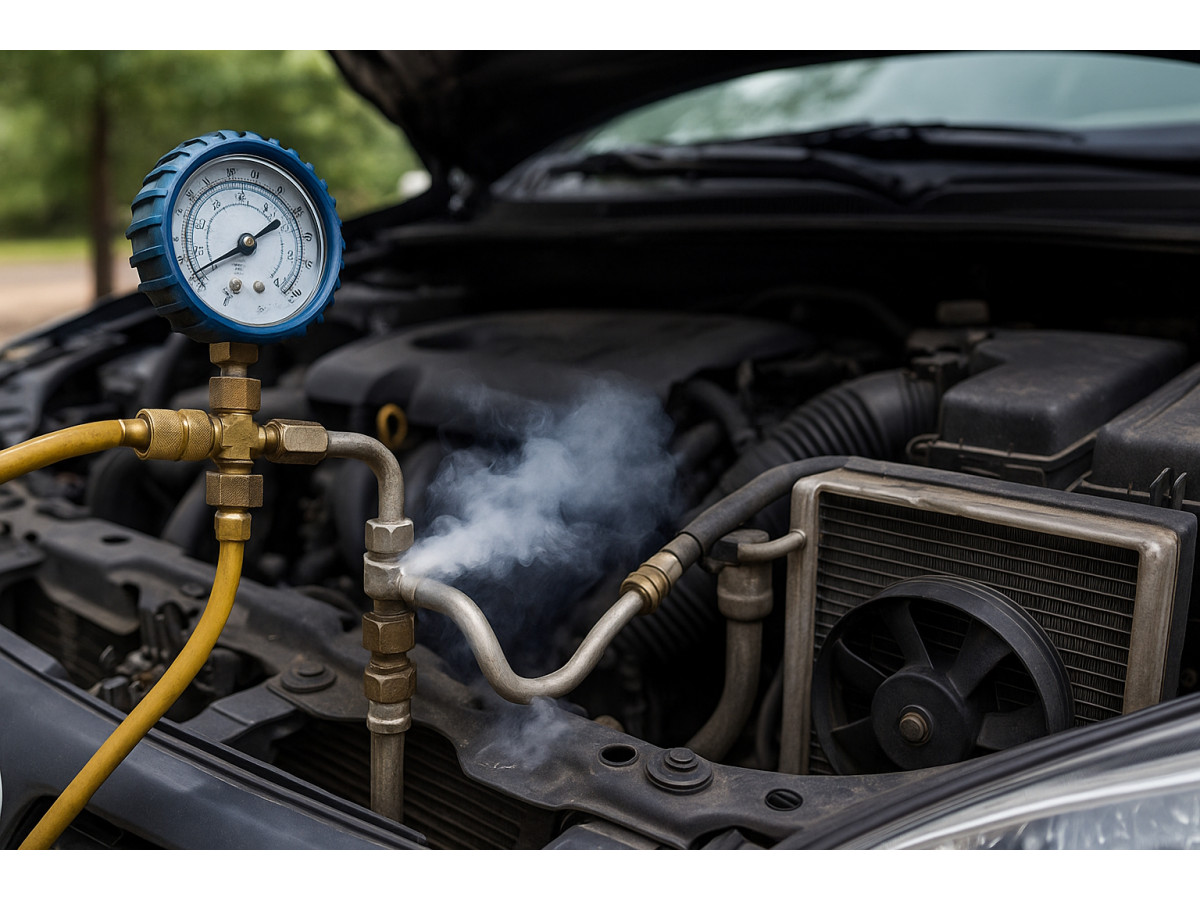
A car air conditioner that cools poorly needs diagnosis, not an automatic recharge. Low refrigerant charge is one possible cause, alongside restricted airflow, condenser fan faults, compressor problems and control issues. A recharge every two to four years is not a universal requirement.
Which symptoms warrant an inspection?
Arrange a check if cooling deteriorates, the system stops unexpectedly or performance soon worsens again after service. Oil traces near a connection can help locate a fault, but their absence does not rule out a leak. Weak airflow can come from a cabin filter or blower problem; an unpleasant smell is not a reliable way to identify refrigerant loss.
Common inspection points include the condenser, hose connections, service ports, compressor seals and evaporator. The location of the leak cannot be established from the age of the car alone.
Some vehicle systems can lose small quantities through permeation over time. This does not justify a fixed recharge interval or topping up without assessment. The workshop needs to establish the condition of the particular system and investigate abnormal loss.
How a workshop finds a refrigerant leak
- Electronic detection: an instrument compatible with the refrigerant checks suspected leak points.
- Approved UV dye: where permitted by the vehicle manufacturer, the correct dye and quantity help reveal escaping oil and refrigerant.
- A suitable pressure test: the workshop may use dry nitrogen or an approved tracer-gas method with the appropriate equipment and manufacturer-specified procedure.
Ordinary smoke testing is not a standard substitute for these refrigerant-circuit methods. Compressed air or oxygen must not be improvised as a test medium. A vacuum-hold test alone does not prove leak-tightness under operating pressure.
What a proper repair should include
Once a leak is confirmed, it should be repaired before the correct charge is restored. The service procedure includes controlled recovery where required, replacement or repair of the faulty component, verification of tightness, evacuation and charging to the manufacturer's specification. Refrigerant must not be deliberately vented during routine service.
The workshop should also check the specified oil type and quantity. This is particularly important for electric compressors, where the oil's electrical properties can matter. A generic “universal oil” is not a substitute for the vehicle specification.
After charging, the technician checks operation under defined conditions and records the refrigerant quantities and repair. The weight recovered is useful evidence, but it does not identify the leak location or explain every cooling fault.
Which refrigerant belongs in the vehicle?
Use the vehicle label and manufacturer service data. R134a and R1234yf are different refrigerants, with different service and safety requirements; they must not be mixed or substituted using adapters. Other vehicle systems may use a different refrigerant altogether.
For background on its applications and limitations, read our R134a properties and uses guide. The product pages for R134a in a 12 kg cylinder and R1234yf in a 5 kg cylinder should be used for purchasing only after the workshop confirms the required specification and buyer eligibility.
Can the owner recharge the system?
Arrange work on the refrigerant circuit with a suitably qualified workshop. Under EU rules, servicing relevant vehicle air-conditioning systems containing F-gases requires the applicable training attestation. A refill can and a single gauge do not establish refrigerant identity, correct charge, oil condition or leak-tightness.
Before the appointment, provide the vehicle identification details, symptoms, previous service records and any history of refrigerant additives. Do not add leak-stop products unless explicitly approved for the vehicle and service procedure.
For the distinction between a service visit and replacement of the charge, see how often refrigerant needs changing. Ask for the next inspection to be based on the manufacturer's guidance and actual findings, with any discovered leak repaired rather than repeatedly topped up.
Write a comment