


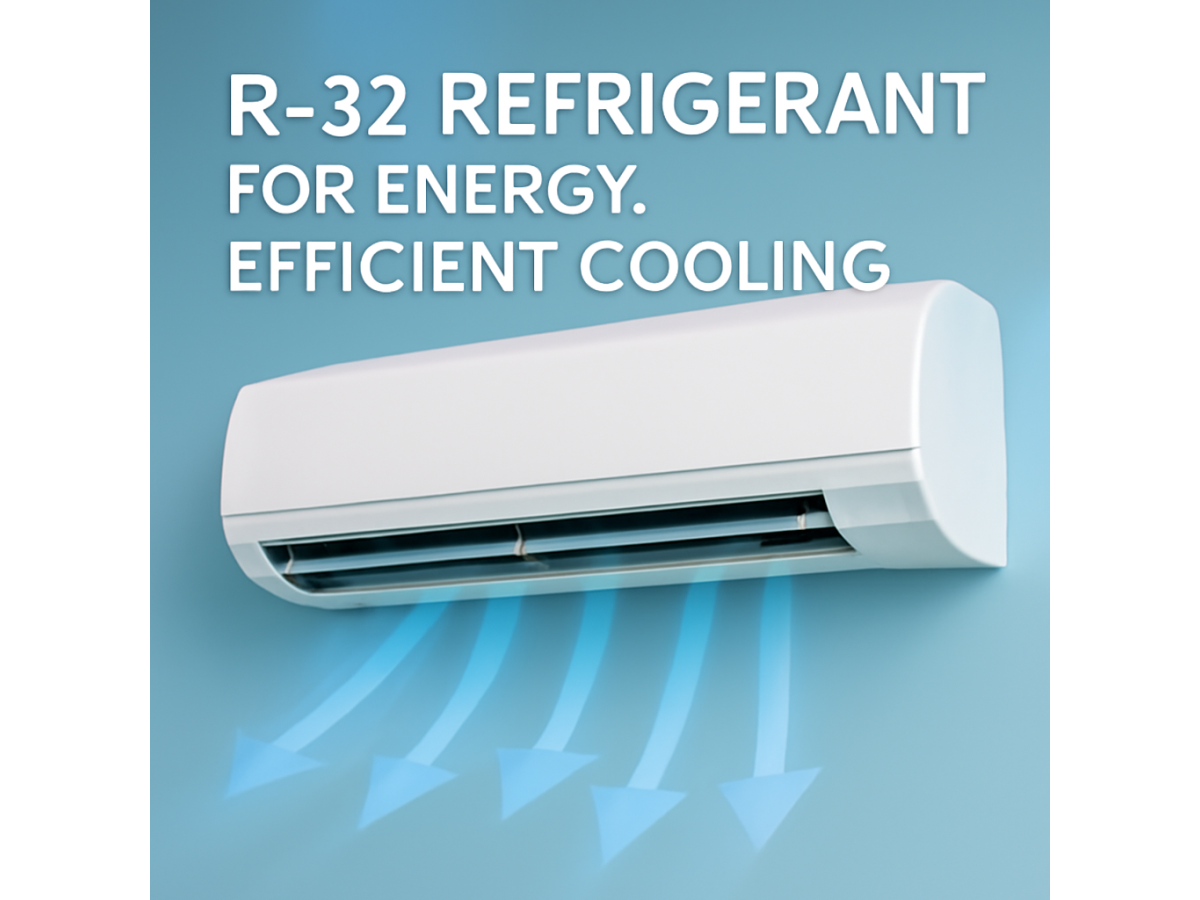
An air conditioner designed for R32 can offer lower running costs than an older, less efficient system. However, R32 alone does not guarantee electricity savings. The result depends on the complete unit: its seasonal efficiency, capacity, installation and operating conditions. For a useful comparison, look at the model's SEER rating and annual electricity consumption, rather than choosing by refrigerant name alone.
How R32 can support energy-efficient air conditioning
R32, also written R-32, is difluoromethane: a single-component hydrofluorocarbon (HFC) used in compatible air conditioners and heat pumps. Its heat-transfer properties allow manufacturers to develop efficient systems, often with a smaller refrigerant charge than comparable R410A designs.
Those advantages depend on equipment designed around the refrigerant. Compressor efficiency, heat exchangers, inverter control and performance at partial load all affect electricity use. An R32 label therefore cannot tell you whether one particular model will cost less to run than another.
R32 vs R410A: GWP is different from energy efficiency
| Property | R32 | R410A |
|---|---|---|
| Composition | Single component | 50% R32 and 50% R125 by mass |
| 100-year GWP, IPCC AR4 basis | 675 | 2,088 |
| Ozone depletion potential (ODP) | 0 | 0 |
| Safety classification | A2L: lower toxicity, lower flammability | A1: lower toxicity, no flame propagation under classification test conditions |
On this basis, R32's global warming potential is approximately 68% lower than R410A's. This compares the climate impact of equal masses released into the atmosphere. It does not mean that an air conditioner uses 68% less electricity.
GWP describes a refrigerant's contribution to global warming; SEER describes a unit's seasonal cooling efficiency. A lower GWP does not itself reduce power consumption. R32 still has a climate impact if released, and zero ODP does not make it environmentally harmless.
How to estimate air conditioner running costs
For split air conditioners sold in the EU, compare the Seasonal Energy Efficiency Ratio (SEER), the cooling design load and the annual cooling electricity consumption on the energy label or product information sheet. Compare equipment with suitable capacity under the same rating method. If you also need heating, check SCOP for the relevant climate.
A simplified estimate is:
- Seasonal electricity use (kWh) ≈ seasonal cooling demand (kWh) ÷ SEER.
- Cooling electricity cost (€) ≈ electricity use (kWh) × electricity tariff (€/kWh).
For example, assume two systems each deliver 6,000 kWh of cooling over a season, with SEER ratings of 5.0 and 6.0. At an illustrative electricity tariff of €0.25/kWh:
| Measure | System A | System B |
|---|---|---|
| SEER | 5.0 | 6.0 |
| Estimated electricity use | 1,200 kWh | 1,000 kWh |
| Estimated cooling electricity cost | €300 | €250 |
The difference is 200 kWh and €50 per season, or about 16.7% less electricity. This is an example based on assumed system ratings, not a measured R32-versus-R410A saving. Actual consumption depends on weather, insulation, temperature settings, operating hours and installation quality. Fixed electricity charges, heating, installation and maintenance costs are excluded.
Can R32 replace R410A or R22 in an existing system?
R32 is not a drop-in replacement for R410A or R22. Do not mix refrigerants or recharge an existing unit with R32 unless the equipment is specifically designed and approved for it. R32 being one component of R410A does not make the two interchangeable.
R32 is an A2L refrigerant, commonly described as mildly flammable. Installation and servicing require suitable equipment, applicable qualifications and compliance with the manufacturer's instructions, including charge and room-size limits where relevant. Replacing an older unit with a compatible R32 model is an equipment decision, not simply a change of gas.
What helps keep an R32 air conditioner efficient?
- Correct sizing: select capacity for the actual cooling load, rather than assuming a larger unit is better.
- Unrestricted airflow: maintain filters and heat exchangers according to the manufacturer's schedule.
- Correct refrigerant charge: have a qualified technician investigate refrigerant loss and repair leaks. Refrigerant is not normally consumed during operation, so repeated top-ups are not routine maintenance.
- Sensible operation: use appropriate temperature settings, shading and schedules to reduce unnecessary cooling.
R32 does not inherently prevent leaks or guarantee cheaper servicing. For a purchase or replacement decision, compare installation, electricity and maintenance costs together. Refrigerant procurement is a separate expense; our guide to refrigerant wholesale price factors in the EU explains what can affect a supply quotation.
R32 and EU rules for new equipment
R32 remains subject to the EU F-gas framework. Regulation (EU) 2024/573 sets different restrictions by equipment category and date. For example, Annex IV sets a GWP limit below 150 for placing split air-to-air systems of up to and including 12 kW on the market from 1 January 2029, subject to the stated safety exception. R32's GWP of 675 exceeds that limit.
This restriction on new equipment does not, by itself, require an already installed R32 air conditioner to stop operating on that date. For a new project, check the rules for its equipment category, timing and installation conditions.
R32 refrigerant supply for HVAC businesses
If your equipment specifies R32, see our R32 refrigerant in 9 kg cylinders for product information and purchasing enquiries. Confirm the required quantity and review the relevant safety data sheet before ordering.
For multiple cylinders or repeat orders, use our wholesale refrigerant enquiry page. Include your company details, quantity and delivery postcode so the quotation can address your supply requirements.
Write a comment