


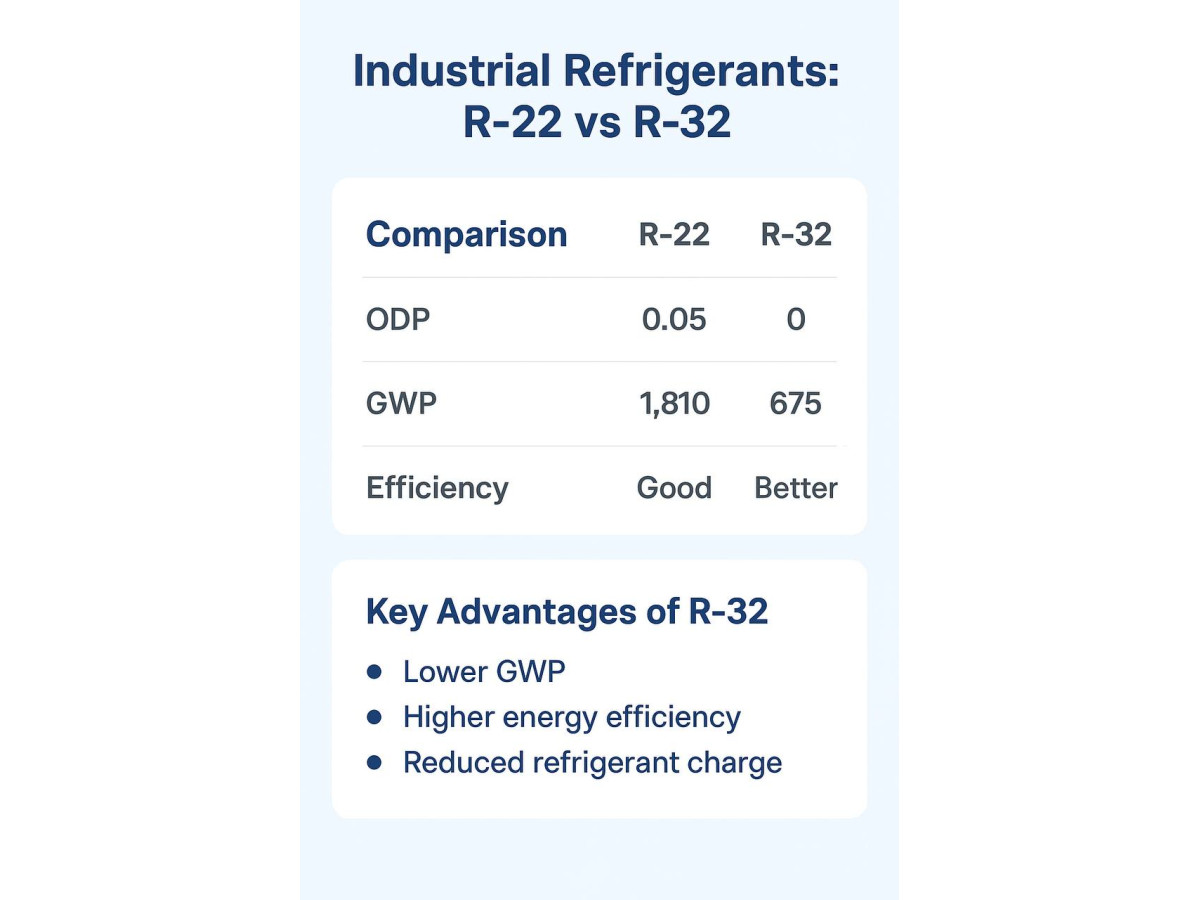
R22 and R32 are not interchangeable refrigerants. For businesses assessing older cooling equipment in the European Union, the priority is to understand the restrictions on R22, check the condition of the installation and choose a technically suitable long-term solution. R32 can be an option for equipment designed for it, but it is not a universal replacement for industrial refrigeration systems.
Can R22 still be used for servicing in the EU?
No. R22 cannot be supplied or used for ordinary maintenance, servicing or refilling of refrigeration and air-conditioning equipment in the EU. R22 is an ozone-depleting hydrochlorofluorocarbon (HCFC). Article 4 of Regulation (EU) 2024/590 prohibits the placing on the market, subsequent supply and use of the ozone-depleting substances listed in Annex I, subject to specific exemptions.
Those exemptions cover narrowly defined activities, such as certain feedstock and essential laboratory uses; they do not authorise routine servicing of cooling equipment with R22. Using reclaimed or recycled R22 does not make such servicing permissible. The EU prohibition on servicing with all R22, including reclaimed and recycled material, has applied since 1 January 2015.
This does not mean that every existing R22 installation must immediately stop operating solely because it contains R22. Continued operation and adding refrigerant are different matters. Existing equipment remains subject to applicable leak-prevention, inspection and safety requirements. If intervention is needed, a qualified contractor should assess the available options without treating an R22 refill as a solution.
R22 vs R32: the main technical differences
| Property | R22 | R32 |
|---|---|---|
| Chemical family | HCFC; chlorodifluoromethane | HFC; difluoromethane |
| Composition | Single-component refrigerant | Single-component refrigerant |
| Ozone depletion potential (ODP) | 0.055 | 0 |
| 100-year global warming potential (GWP, IPCC AR4) | 1,810 | 675 |
| Safety classification | A1: lower toxicity class, no flame propagation under standard test conditions | A2L: lower toxicity class, lower flammability with low burning velocity |
| Application context | Legacy refrigeration and air-conditioning equipment | Air conditioners, heat pumps and selected chillers specifically designed for R32 |
The R22 ODP value uses the Montreal Protocol basis. Both GWP figures use the same IPCC assessment, AR4, for a consistent comparison; figures from other assessments can differ. These properties do not establish that two refrigerants are compatible with the same equipment.
Can R32 replace R22 in an existing system?
R32 is not a drop-in replacement for R22. It has different pressure-temperature characteristics and an A2L safety classification. An R22 installation cannot be assumed to have suitable components, controls or safety provisions for R32.
Replacing the refrigerant requires more than selecting a gas with a lower GWP. The assessment must address the compressor operating limits, lubricant compatibility, seals, expansion device, pipework and control settings. Flammability requirements also depend on the equipment design, refrigerant charge and installation location. An oil change or system flush alone does not demonstrate compatibility.
Do not mix refrigerants or choose an alternative solely because it is available for purchase. Any conversion needs an appropriate documented technical basis and confirmation against the equipment and compressor manufacturers' requirements.
What are the options for an existing R22 installation?
Assess the condition and remaining service life
Start with the equipment model, refrigerant identification, maintenance history, leak history and measured performance. A sound installation and an ageing system with recurring faults may justify different decisions. For a cold store or production process, include the cost of an unplanned shutdown when comparing options.
Evaluate a manufacturer-supported retrofit
A retrofit may be feasible for some systems, but there is no replacement refrigerant suitable for every R22 installation. Ask the original equipment manufacturer (OEM) or a qualified refrigeration specialist to identify a documented conversion option. Check the proposed refrigerant against applicable EU restrictions, then assess the required modifications, expected capacity, efficiency and remaining equipment life.
Compare the cost of replacement equipment
If the installation is deteriorating, inefficient or unsuitable for a supported conversion, replacement may be the more practical investment. Specify new equipment for the actual cooling duty. R32 should enter the comparison only where a manufacturer offers suitable equipment for that application. Recovered R22 must be handled through an authorised recovery and waste-management route, not released into the atmosphere.
How to choose a refrigerant for industrial equipment
A refrigerant suitable for comfort cooling is not automatically suitable for a freezer, process chiller or other industrial installation. Compare complete system designs using the following requirements:
- Cooling duty: required temperatures, capacity, ambient conditions and hours of operation.
- Equipment compatibility: manufacturer specifications, operating limits and availability of a documented retrofit procedure where relevant.
- Safety: refrigerant classification, installation location, charge limits and any required ventilation or leak detection.
- Energy performance: efficiency at the expected temperatures and loads, including part-load operation.
- Lifetime cost: installation, electricity, servicing, downtime, spare parts and eventual decommissioning.
- EU regulatory requirements: restrictions affecting the equipment category, refrigerant and planned installation or servicing date.
R32 has zero ODP, but it is still a fluorinated greenhouse gas. Its use is subject to Regulation (EU) 2024/573, including equipment-specific restrictions and phase-out dates. It should not be described as unrestricted or suitable for every future project.
Does R32 automatically reduce energy costs?
No. A lower GWP describes a lower potential climate impact per kilogram released; it does not measure electricity consumption. Energy costs depend on the complete system, its sizing, controls, operating conditions and maintenance.
For air conditioners, compare seasonal efficiency ratings under comparable conditions. For industrial cooling, compare equipment performance at the temperatures and loads the process actually requires. Our guide to R32 and air-conditioner energy costs explains how to assess efficiency without attributing a guaranteed saving to the refrigerant alone.
Buying refrigerant for compatible equipment
Confirm the refrigerant specified for the equipment before ordering. For systems designed and approved for R32, see the R32 refrigerant in a 9 kg cylinder product page. This product is not a replacement recommendation for an R22 system.
For business quantities, submit a wholesale refrigerant enquiry with the required refrigerant designation, quantity and delivery destination. For an existing R22 installation, establish the approved retrofit or equipment replacement plan before selecting a refrigerant supply.
Write a comment