


Choosing a refrigerant with a lower global warming potential can reduce the climate impact of refrigerant emissions. For businesses operating refrigeration, air-conditioning or heat-pump systems, this can support a measurable emissions-reduction programme.
The benefit depends on the complete project: equipment compatibility, refrigerant charge, leakage, electricity consumption and end-of-life recovery. A lower GWP does not automatically reduce the company's total carbon footprint by a fixed percentage, guarantee energy savings or establish compliance with every regulation.
What benefits can a lower-GWP refrigerant provide?
Global warming potential, or GWP, compares the climate effect of emitting a gas with that of emitting the same mass of CO₂ over a specified period, usually 100 years. A lower value means a smaller climate impact when the same mass is released.
For a business, the potential benefits include:
- Lower direct climate impact: an equal refrigerant loss produces fewer tonnes of CO₂ equivalent.
- Better equipment planning: refrigerant selection can be assessed against the requirements applying to the intended equipment category and installation date.
- More useful environmental reporting: documented changes in refrigerant emissions can support specific, verifiable statements to customers and partners.
GWP does not describe ozone depletion, toxicity, flammability or every other environmental characteristic. A refrigerant should not be described as environmentally harmless simply because its GWP is low.
Why an 80% reduction in refrigerant emissions is not an 80% smaller company footprint
Direct refrigerant emissions can be expressed using the following calculation:
Tonnes of CO₂ equivalent = refrigerant released in kg × GWP ÷ 1000.
The quantity contained in a sealed system is not an actual emission. Estimating annual releases requires appropriate service records or a refrigerant mass balance, rather than treating every kilogram purchased as a kilogram emitted.
A company's inventory may also include electricity, heating, transport, purchased goods and other activities. In GHG Protocol accounting, HFC leaks from equipment within the company's reporting boundary generally contribute to Scope 1, while emissions from purchased electricity contribute to Scope 2. Other value-chain emissions may fall within Scope 3.
The following is a hypothetical example, using the same annual reporting boundary before and after the project:
| Annual emissions | Before, t CO₂e | After, t CO₂e |
|---|---|---|
| Refrigerant emissions | 10 | 2 |
| All other emissions within the boundary | 90 | 90 |
| Total | 100 | 92 |
Here, refrigerant emissions decrease by 80%, but the total decreases by 8%. This is an illustration, not a forecast for a particular refrigerant or installation. Actual results depend on the starting emissions, changes in leakage and charge, energy use and the scope of the assessment.
Energy efficiency and operating costs need a separate comparison
Refrigerant properties affect system design, but GWP is not an energy-efficiency rating. A lower-GWP system may use less electricity when its compressor, heat exchangers and controls are designed and selected appropriately. The refrigerant name alone cannot establish that result.
Compare equipment at the required cooling or heating capacity and under equivalent operating conditions. For relevant air-conditioning and heat-pump equipment, review seasonal performance figures such as SEER and SCOP. For refrigeration systems, examine performance at the actual evaporating and condensing conditions and the expected annual load.
A business case should include equipment or conversion costs, installation, downtime, energy, servicing and eventual refrigerant recovery. A cheaper cylinder or a lower GWP does not by itself demonstrate a shorter payback period.
Lower-GWP refrigerants are not interchangeable
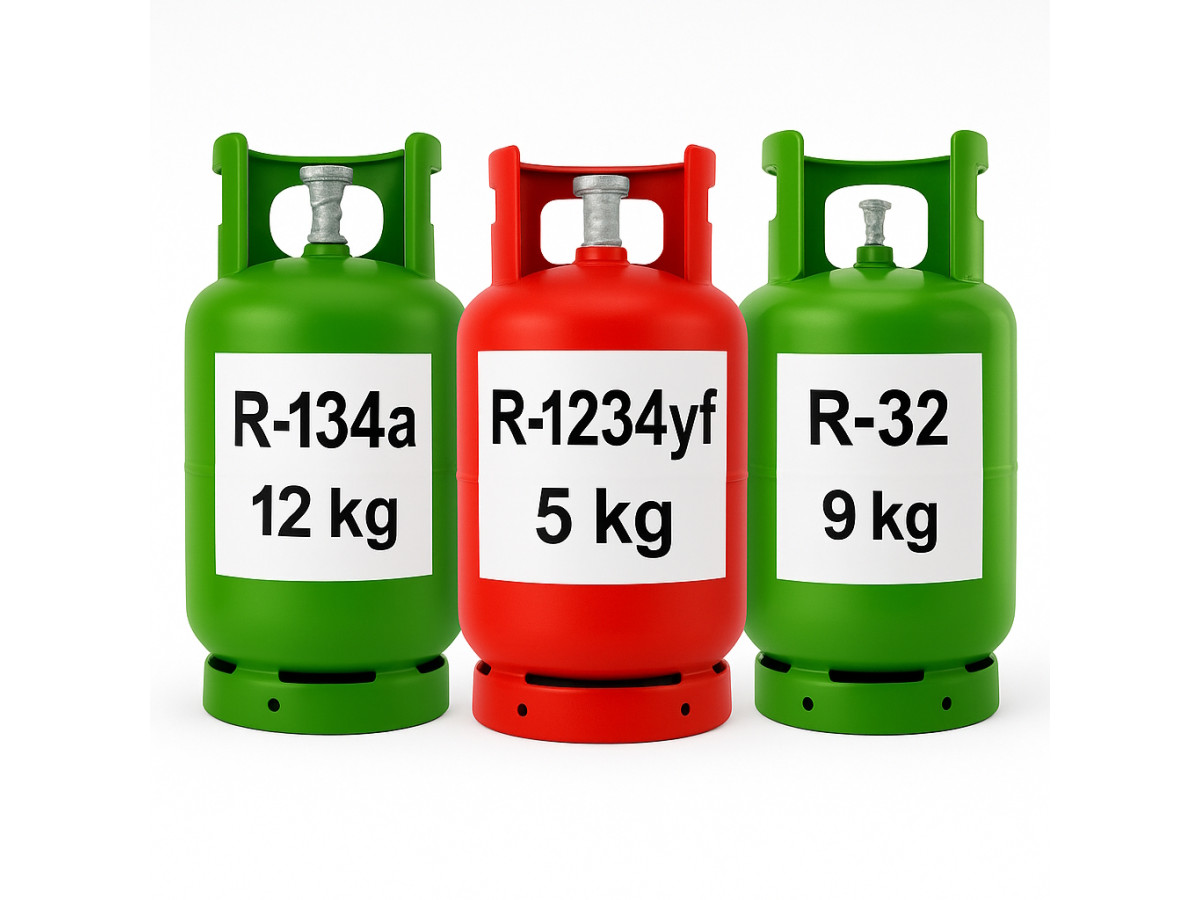
R32 and R454B have lower GWP values than R410A, while R513A has a lower GWP than R134a. Their applications and safety classifications differ, so they cannot be treated as equivalent purchasing options.
| Refrigerant | Safety class | Key selection condition |
|---|---|---|
| R32 | A2L | Use in equipment designed for R32; not a drop-in replacement for R410A. |
| R454B | A2L | Use in equipment specifically designed for this refrigerant. |
| R513A | A1 | A candidate for selected R134a applications, subject to manufacturer approval and the required conversion procedure. |
| R1234yf | A2L | Used in systems designed for it, including many vehicle air-conditioning systems; not a universal R134a refill option. |
“Lower GWP” is a comparison, not a universal regulatory category. For example, R32 has a GWP100 of 675 under the EU F-gas reference values, compared with approximately 2088 for R410A. It still does not meet a requirement for GWP below 150.
For existing air-conditioning installations, our article on R410A applications and limitations explains why equipment specifications remain central to refrigerant selection.
A2L safety: precautions reduce risk rather than eliminate it
A2L identifies refrigerants with lower toxicity and lower flammability, including a low burning velocity under the classification criteria. These refrigerants can still ignite under suitable conditions. Correct installation does not remove that physical property.
The design and installation assessment must address the refrigerant charge, room size, equipment location, potential ignition sources and the ventilation or leak-detection measures required for the application. Components, service tools and recovery equipment must be suitable for the refrigerant.
Work should be performed by personnel with the required qualifications and relevant training. The manufacturer's instructions, safety data sheet and applicable safety requirements determine the precautions. An A1 classification also does not mean that pressure, oxygen displacement or other hazards can be ignored.
Does a lower GWP automatically ensure EU compliance?
No. Regulation (EU) 2024/573 includes different requirements for placing equipment on the market, installation, servicing, leak prevention, recovery and personnel qualifications. The applicable restrictions depend on the equipment category, capacity where relevant, refrigerant, date and any specified exceptions.
A refrigerant may have a lower GWP than its predecessor while remaining above the limit for a particular application. A safety classification or the description “next generation” is not a certificate of regulatory compliance.
Assess the rules applying to the proposed installation and its expected service life. Purchasing a lower-GWP refrigerant does not automatically authorise an equipment conversion or guarantee that future restrictions will never affect it.
A practical transition plan for a business
- Inventory the equipment. Record models, refrigerants, charges, condition and available manufacturer documentation.
- Establish the baseline. Collect refrigerant service records, electricity consumption and information about operating hours and cooling demand.
- Identify the technical route. Distinguish servicing with the existing refrigerant, an approved retrofit and replacement with new equipment.
- Check safety and regulations. Confirm compatibility, installation conditions and the requirements applying to the proposed system.
- Compare total costs. Include conversion work, training, downtime, energy and maintenance over the intended operating period.
- Measure the outcome. Compare actual refrigerant emissions and electricity use under comparable conditions.
The technical assessment behind a conversion is illustrated in our comparison of R407C and R22. A lower environmental indicator alone is not enough to approve a retrofit.
What to confirm before ordering refrigerant
Confirm the exact refrigerant designation, manufacturer approval, required quantity, safety data sheet and product identification. Keep records of charging, recovery and servicing so that subsequent environmental claims can be checked.
For equipment whose manufacturer specifies R32, see the R32 9 kg product page. Other available product types and pack sizes can be reviewed in our refrigerant catalogue.
A defensible result is a measured reduction over a stated period and reporting boundary. Use consistent GWP values and the methodology required for the relevant reporting purpose, and identify separately any savings in electricity or operating costs.
Write a comment