


High humidity in a warehouse can cause condensation, frost on evaporators and damage to stored goods. However, humidity alone does not determine which refrigerant the installation needs. Reliable climate control depends on the storage requirements, cooling and moisture loads, equipment design and operating conditions.
R407C and R410A are not universally better choices for humid warehouses. The refrigerant must match the equipment, while humidity problems require an assessment of moisture sources, air distribution, heat exchangers and controls.
Start with the storage requirements
Define the required temperature and relative humidity for the actual goods, packaging and storage duration. Some fresh products need relatively high humidity to limit moisture loss, while other goods require a drier environment. A single humidity target cannot suit every warehouse.
It is also important to distinguish a refrigerated store from a warehouse that only needs humidity control. If the temperature is already suitable, a properly designed dehumidification system may be more appropriate than additional cooling. Product specifications should guide that decision.
How humid air affects a refrigeration system
When warm, moist air enters a cold store, the installation must remove both heat and excess water vapour. Moisture can condense on surfaces below the air’s dew point. On sufficiently cold evaporator surfaces, frost can accumulate and eventually restrict airflow and heat transfer.
Common moisture sources include frequently opened doors, poorly sealed loading bays, wet cleaning and exposed products. Relative humidity should always be assessed together with temperature: a change in temperature can alter the relative humidity reading even when the amount of water vapour has not changed.
Condensation on a wall or package therefore calls for a comparison of surface temperature and air dew point. Changing the refrigerant does not correct a damaged door seal or a thermal bridge.
How to select the refrigerant correctly
For an existing installation, start with the nameplate, service records and manufacturer’s documentation. Any conversion requires a documented technical assessment. Refrigerants must not be mixed or substituted simply because another product is advertised as suitable for humid conditions.
For a new installation, the designer should evaluate:
- Operating conditions: storage temperature, cooling capacity, moisture load and ambient conditions.
- Component compatibility: compressor operating envelope, lubricant, expansion device, heat exchangers and pressure ratings.
- Safety requirements: refrigerant classification, charge size, room layout and necessary protective measures.
- Long-term operation: energy performance, maintenance access, refrigerant availability and applicable restrictions.
R407C and R410A have been used in air-conditioning and heat-pump equipment, but neither designation proves suitability for a particular cold store. R407C has a temperature glide that must be considered during equipment selection. R410A requires components designed for its operating pressures. They are not interchangeable, and neither is a low-GWP refrigerant.
For additional context, read our guide to R410A applications and equipment compatibility.
In the EU, Regulation (EU) 2024/573 sets different restrictions for new equipment and servicing. Check the relevant equipment category, refrigerant and application date.
What condensation and frost can tell you
Visible symptoms help organise an inspection, but they do not identify a fault on their own.
| Observation | Possible causes | What to check |
|---|---|---|
| Heavy frost on the evaporator | Moisture ingress, inadequate airflow, ineffective defrost or refrigerant feed problems. | Door activity, fans, coil condition, defrost operation and measured operating parameters. |
| Water on walls or packaging | Surfaces below the dew point, thermal bridges or contact with warm, moist air. | Surface temperatures, air temperature and humidity, insulation and loading procedures. |
| Correct temperature but excessive humidity | High moisture input, insufficient moisture removal or unsuitable control settings. | Humidity sensor accuracy, operating cycles and the balance between cooling and moisture loads. |
| Products losing too much moisture | Excessive dehumidification, unsuitable airflow or storage conditions. | Product requirements, air distribution and evaporator selection. |
A practical approach to humidity control
- Record conditions over representative operating periods. Log temperature and humidity at suitable storage locations, together with deliveries, door openings and defrost events.
- Reduce uncontrolled air entry. Inspect door seals, loading-bay interfaces and openings in the building envelope. Review how long doors remain open during handling.
- Check airflow and drainage. Keep goods clear of designed air paths and have evaporators, drain pans and condensate lines inspected and maintained.
- Review defrost control. Its timing, termination and drainage arrangements should match the equipment and actual frost load.
- Match humidity control to the goods. Where cooling alone cannot maintain the required conditions, assess dedicated dehumidification or revised system controls.
Evaporator selection also matters. In applications requiring high humidity, an appropriate smaller difference between room temperature and refrigerant evaporating temperature can help limit product drying. The design must still provide the necessary cooling capacity and moisture removal.
Moisture inside the refrigerant circuit is a separate problem
Warehouse air and the refrigerant circulate on opposite sides of the heat exchanger. High room humidity does not, by itself, mean that the refrigerant is contaminated. Water can enter the circuit through poor installation practices, wet components or exposure to air during servicing.
POE lubricants used in many systems absorb moisture from air. If contamination is suspected, a qualified technician should assess the circuit and follow the manufacturer’s drying, evacuation and component replacement procedures. A refrigerant filter-drier treats moisture inside the circuit; it does not dehumidify the warehouse.
How to assess energy savings
Maintenance and improvements can reduce avoidable energy use, but a fixed saving cannot be promised for every warehouse. Establish a baseline and compare electricity consumption over equivalent periods, accounting for weather, incoming product temperature, throughput, door activity and storage settings.
Energy reduction (%) = (adjusted baseline consumption − consumption after improvements) / adjusted baseline consumption × 100.
The baseline should represent what the installation would have consumed under the comparison conditions. Include compressors, fans, defrost heaters and any added dehumidification equipment within a consistent measurement boundary. Confirm that product temperature and humidity requirements remain satisfied.
What to check before ordering refrigerant
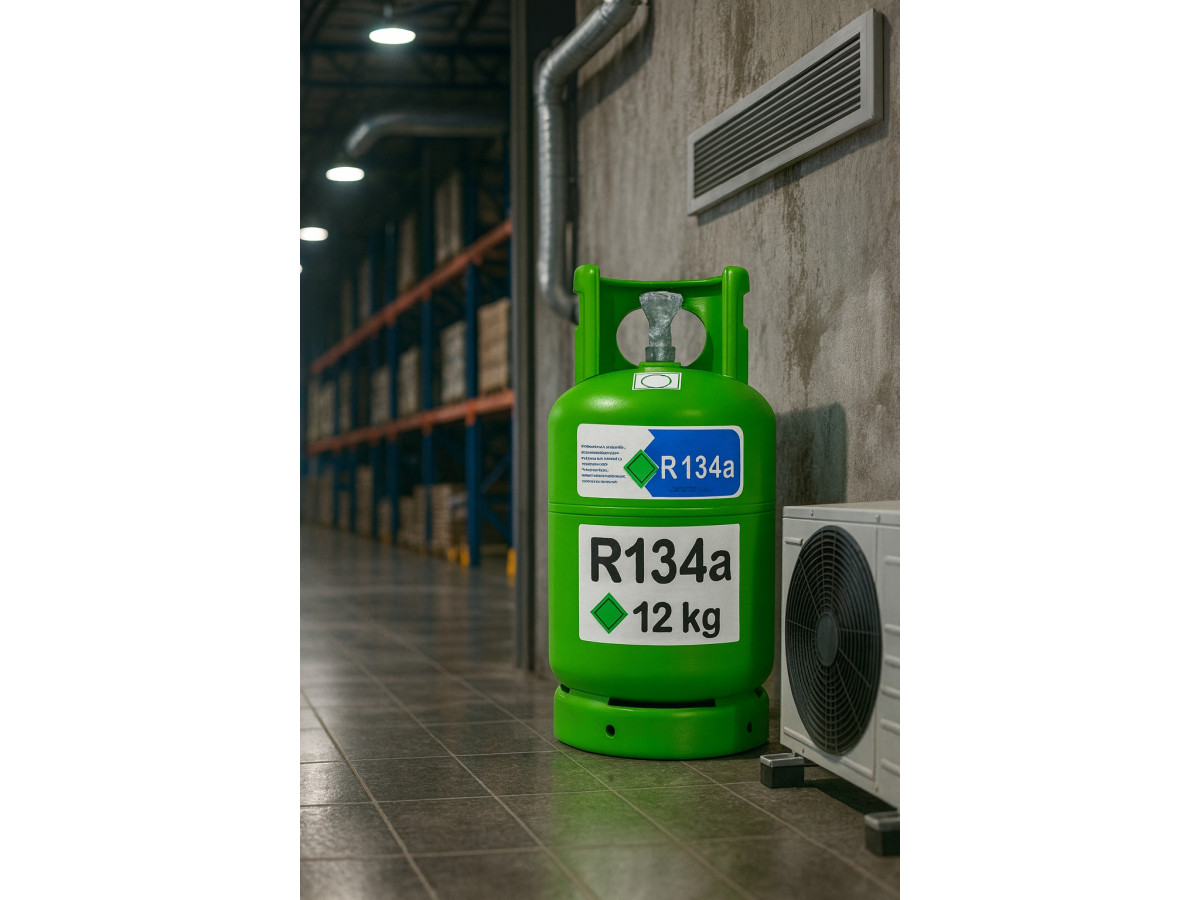
Identify the approved refrigerant, installation model and required service quantity before purchasing. For equipment specifically designed for these refrigerants, the store includes product pages for R134a refrigerant in a 12 kg cylinder and R410A refrigerant in a 10 kg cylinder.
These are different products for different equipment requirements. The cylinder’s contents do not determine the correct system charge. Confirm compatibility, documentation and permitted use with the servicing specialist.
Frequently asked questions
Does frost prove that the system needs more refrigerant?
No. Frost can result from moisture ingress, airflow restrictions, defrost faults or other operating problems. Refrigerant charge should be assessed through the manufacturer’s diagnostic procedure.
Should refrigerant be replaced regularly in a humid warehouse?
A sound closed circuit does not normally consume refrigerant. Replacement or additional charging requires a diagnosed reason, such as a repaired leak or a service operation. A pressure reading alone is insufficient.
Further explanations are available in our frequently asked questions about refrigerants.
Write a comment