


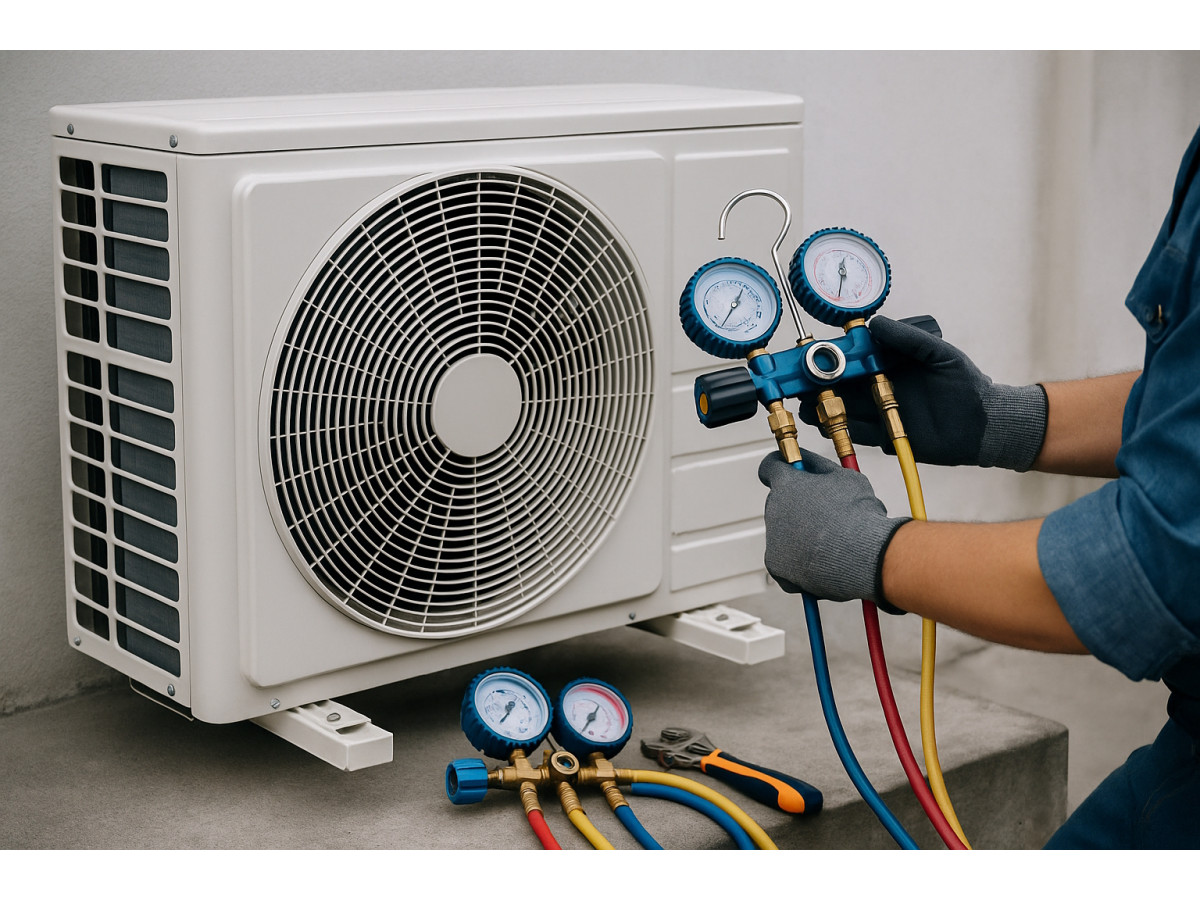
An air conditioner that cools poorly does not necessarily have a refrigerant leak. Dirty filters, restricted airflow, control faults and an incorrect initial charge can cause similar problems. A reliable diagnosis combines an assessment of system operation with tests that locate the actual leak.
Refrigerant circulates in a closed circuit and is not consumed during normal operation. Repeatedly adding refrigerant without investigating the loss does not resolve the underlying fault.
Which symptoms can indicate a refrigerant leak?
The following observations justify checking the equipment, but none confirms a leak on its own.
| Observation | What it actually tells you |
|---|---|
| Reduced cooling | Possible causes include insufficient refrigerant, dirty heat exchangers, incorrect settings or an unusually high cooling load. |
| Weak airflow | Check filters, air passages, the fan and possible evaporator icing. Airflow alone does not indicate how much refrigerant is present. |
| Ice on the indoor coil during cooling | Undercharging is one possibility, but restricted airflow and refrigerant flow problems can produce similar icing. |
| Oily marks around a connection | Oil can escape with refrigerant. The area deserves inspection, although old service residue can leave similar marks. |
| An unusual smell | Refrigerant may have no noticeable odour. Smells can originate from drains, contamination or electrical faults; they are not a reliable leak test. |
| A higher electricity bill | Weather, operating hours, temperature settings and electricity prices also affect the bill. No fixed percentage increase confirms a leak. |
What can the owner check safely?
- Check the operating mode, temperature setting and accessible filters according to the user manual.
- Record error codes and when the problem occurs. Photographs of icing or oily marks can help the technician.
- If there is substantial icing, repeated protective shutdown or a confirmed leak, stop using the equipment and arrange service.
If a significant refrigerant release is suspected indoors, leave the affected area, avoid ignition sources and obtain professional assistance. Ventilate only if this can be done safely. Do not attempt to identify refrigerant by deliberately smelling it.
Why do refrigerant leaks develop?
Possible sources include defective flared or brazed joints, service valves, damaged seals, corroded heat exchangers and tubing weakened by vibration or rubbing. Installation damage and mechanical stress can also affect tightness.
Insufficient evacuation is a separate service problem: it can leave air and moisture inside the circuit. It does not, by itself, prove that the system leaks. Equally, an undercharged system may have been incorrectly charged during installation rather than having lost refrigerant afterwards.
How does a technician confirm and locate a leak?
The technician first identifies the refrigerant and checks the equipment documentation, airflow, temperatures and operating conditions. Pressure readings are interpreted together with these findings. There is no single “correct pressure” that diagnoses every air conditioner regardless of temperature, load and operating mode.
- Electronic leak detection: a detector suitable for the refrigerant helps locate escaping gas around joints, valves and heat exchangers.
- Approved bubble solution: a suitable leak detection fluid can reveal leakage at accessible points.
- Dry nitrogen testing: where required, the technician tests the relevant circuit according to the manufacturer's pressure limits and procedure. Oxygen and compressed air must not be used as substitutes.
- Operating measurements: temperatures, pressures and, where applicable, superheat and subcooling help assess the charge and distinguish other faults.
Evacuation removes air and moisture. A vacuum check does not locate a leaking joint or replace the pressure and leak tests specified for the equipment.
What should a proper leak repair include?
- Locate the defect. Establish which component or connection is leaking and assess its condition.
- Recover refrigerant as required before opening the circuit. Use suitable recovery equipment and containers instead of releasing refrigerant into the atmosphere.
- Repair or replace the faulty part. Depending on the defect, this may involve a connection, valve, pipe section or heat exchanger.
- Verify tightness and prepare the circuit. Carry out the required tests, evacuation and drying before charging.
- Restore the specified charge and check operation. Follow the manufacturer's charging procedure, including any allowance for pipe length, and document the final checks.
Repair time and cost depend on access, the location of the leak, the condition of the equipment, spare parts and the testing required. A leaking valve and a damaged concealed pipe are different jobs. A reliable estimate follows diagnosis, rather than a universal promise of a repair within a set number of minutes.
Does every leak require replacing the entire refrigerant charge?
Not necessarily. After repairing the leak, the technician decides whether a controlled top-up is permitted or whether recovery and a complete recharge are required. This depends on the manufacturer's instructions, the refrigerant, the nature of the loss and whether the remaining charge has a known composition and condition.
For refrigerant blends, the applicable charging procedure must preserve the intended composition. Mixing different refrigerants or repeatedly topping up a leaking system is not an acceptable substitute for repair.
Which refrigerant should be used after repair?
Use the refrigerant specified for the equipment or documented in an approved conversion. R32, R410A and R407C are not interchangeable simply because they are used in air conditioning.
For equipment specified for R410A, see the R410A refrigerant in a 10 kg cylinder. The cylinder quantity is a purchasing format, not the required charge for an individual air conditioner.
For background on refrigerant properties and compatibility, read our comparison of refrigerant types for air conditioners.
What if the air conditioner originally used R22?
In the European Union, charging or topping up an air conditioner with R22 is prohibited, including reclaimed or recycled R22. A leaking R22 system therefore requires an assessment of a technically suitable, legally permitted conversion or equipment replacement.
- R407C: a possible retrofit option for certain systems, typically requiring a compatible POE lubricant and checks of components, controls and operating conditions.
- R438A: an option for certain direct expansion systems. Existing mineral or alkylbenzene oil can sometimes be retained, but oil return, seals and system performance still require assessment.
Neither refrigerant is a universal drop-in replacement. Flushing or changing the oil alone does not establish compatibility. Consider R407C refrigerant in a 10 kg cylinder only after the service company has confirmed its suitability and the required conversion procedure.
For equipment with extensive corrosion, repeated failures or an unsuitable compressor, replacement may be more practical than conversion.
What should you receive after the repair?
Ask the service company to record:
- the leak location and the repair performed;
- the refrigerant type and quantities recovered or added;
- the results of leak tests and operating checks;
- any required follow-up inspection and maintenance recommendations.
A sound system does not need an annual refrigerant top-up simply because another year has passed. Maintenance should follow the equipment instructions and operating conditions.
In the EU, detected F-gas leaks must be repaired without undue delay. Relevant refrigerant work requires the applicable certification. Mandatory leak-check intervals depend on the refrigerant, charge and equipment category.
For further discussion of common servicing assumptions, see our article on refrigerant myths that air conditioner owners should know.
Write a comment