


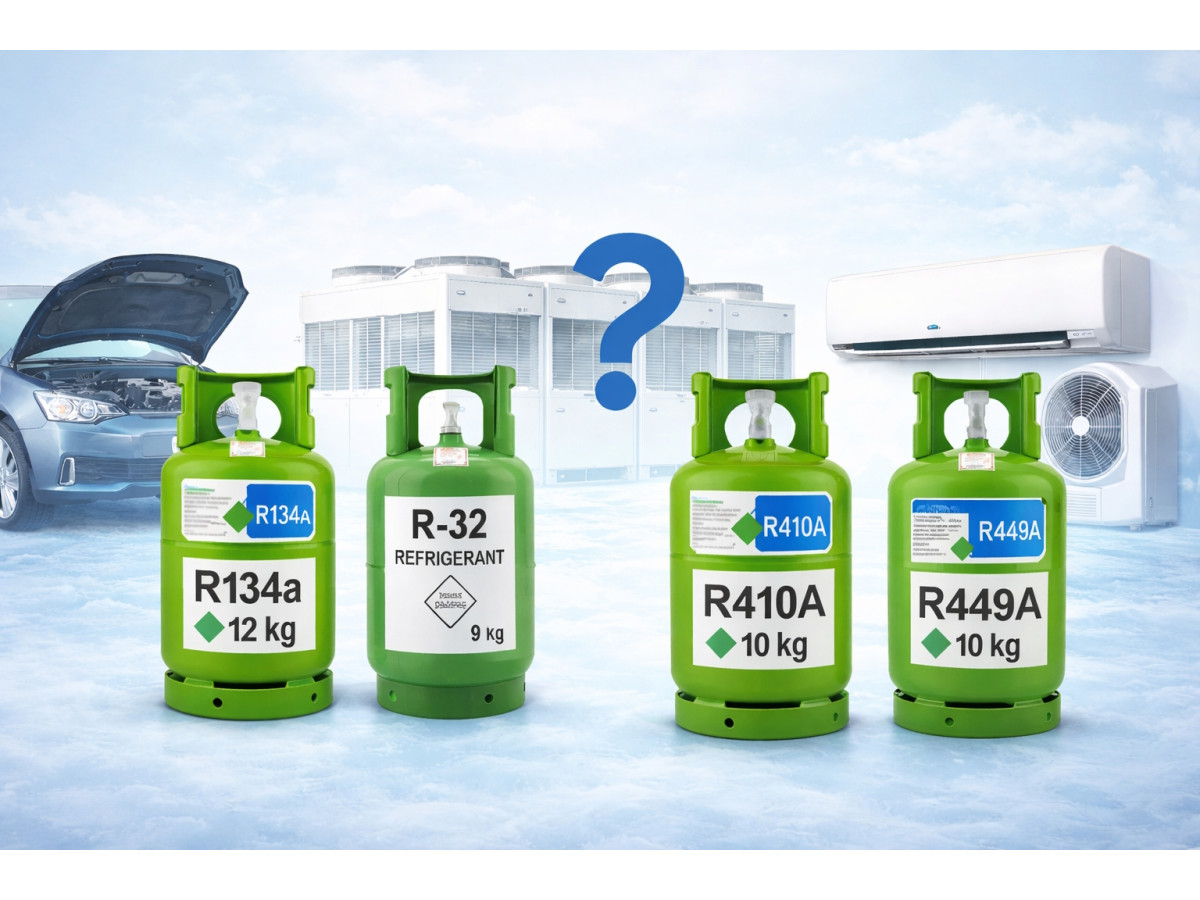
The same refrigerant can be used in different equipment categories, provided each particular model is designed and approved for it. That does not make the refrigerant universal. Compatibility follows the specification of the individual appliance, not simply the words “refrigerator”, “air conditioner” or “heat pump”.
A shared cooling principle, different design conditions
Most conventional refrigerators and air conditioners use a vapour-compression cycle: refrigerant absorbs heat in the evaporator, is compressed, rejects heat in the condenser and passes through an expansion device. Reversible heat pumps use the same basic principle while changing where useful heat is delivered.
The differences concern evaporating and condensing temperatures, capacity, compressor design, controls, heat exchangers and operating conditions. Both refrigerators and air conditioners may cycle on and off or modulate capacity. It is inaccurate to distinguish them by claiming that one always runs continuously and the other only cycles.
Examples of refrigerants used across applications
| Refrigerant | Examples of equipment designed for it | Key limitation |
|---|---|---|
| R134a | Existing vehicle AC, some chillers and commercial refrigeration equipment | Oil and compressor requirements differ between applications |
| R410A | Existing air conditioners, heat pumps and certain chillers | High GWP; use and equipment restrictions require checking |
| R32 | Approved air conditioners and heat pumps | A2L classification requires appropriate design and service provisions |
| R290 | Commercial refrigeration, heat pumps and certain air conditioners | A3 flammability; charge and installation requirements are equipment-specific |
| R600a | Domestic refrigerators and some light commercial appliances | A3 flammability; unsuitable as an improvised conversion charge |
R600a, or isobutane, is therefore not restricted to domestic refrigerators. It is also used in selected light commercial equipment, including certain compact cabinets and beverage coolers. That does not mean it can replace R134a in any such cabinet.
What must match besides the refrigerant name?
- The approved operating envelope: pressures, temperatures and compressor cooling requirements.
- Lubrication: the exact oil specification, viscosity and charge.
- Metering and controls: expansion device, sensors, settings and protection functions.
- Safety provisions: permitted charge, installation location, ventilation and ignition-source controls where applicable.
- Applicable rules: equipment category, intended activity and the date of installation or servicing.
For example, a vehicle AC system and a chiller may both use R134a while requiring different oils and service equipment. The common refrigerant does not make their maintenance procedures interchangeable. See our article on the risks of using an incorrect refrigerant for the consequences of an unapproved choice.
Can one supply cylinder serve several compatible systems?
A suitable cylinder of uncontaminated refrigerant may supply several systems that require exactly that product, with the required qualifications and lawful purchasing conditions. Service equipment and procedures must prevent contamination between jobs.
Gas recovered from another appliance is a different question. Its identity, quality, legal reuse conditions and suitability for the receiving system must be established. Do not transfer unidentified recovered gas or combine it with fresh stock merely because the original appliances carried the same designation.
How to simplify purchasing without forcing compatibility
For a fleet of equipment, keep a register of model numbers, refrigerants, installed charge, approved oils and service responsibilities. This allows purchasing to group genuine common requirements while keeping different refrigerants and recovered material separate.
Our guide to five common refrigerant myths covers related misunderstandings about charging and maintenance. Reducing the number of stocked products can be considered when selecting new equipment; it is not a reason to refill existing machines with a common “universal” gas.
Use the refrigerant catalogue to identify the specified products. The R134a 12 kg product page, for example, is relevant only for confirmed R134a requirements. Check the technical specification and supply conditions before placing a combined order.
Write a comment