


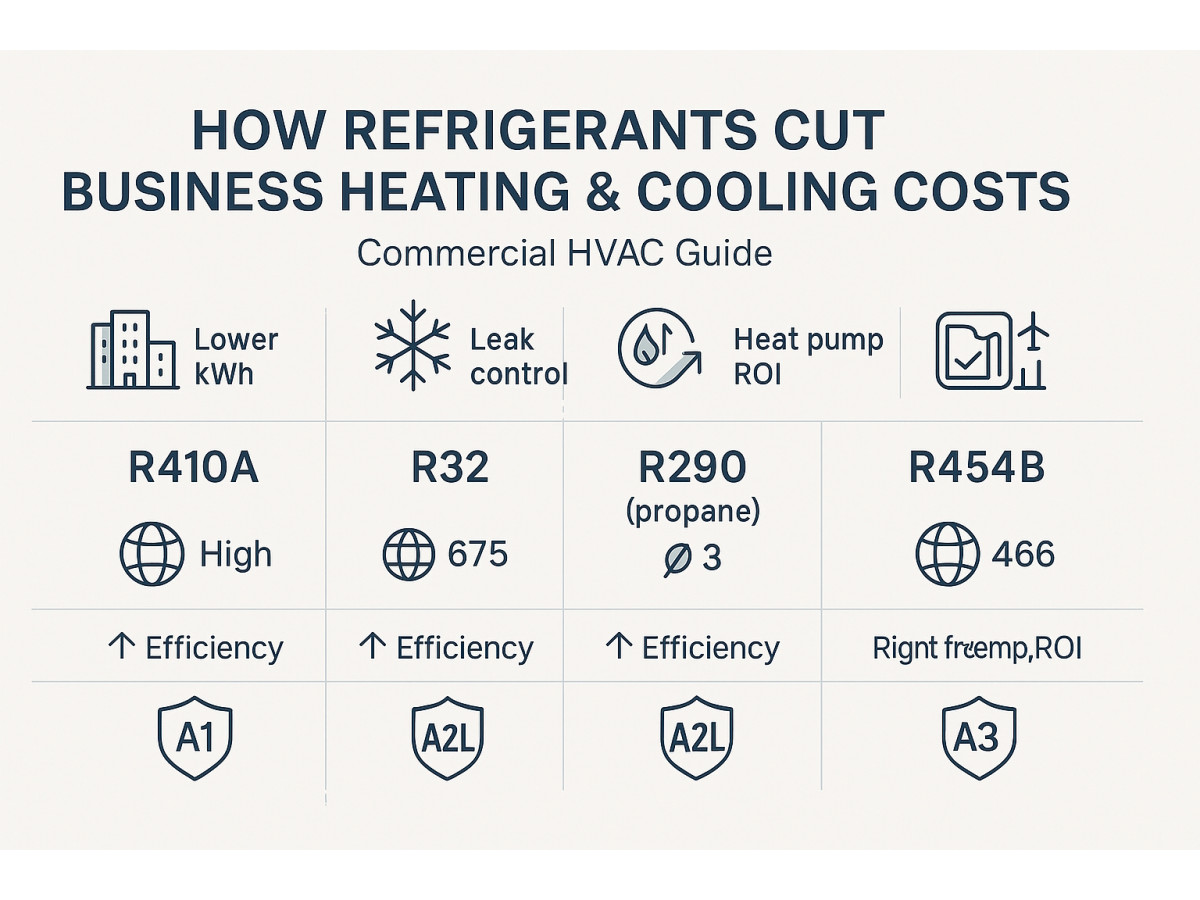
Lower heating and cooling bills depend on the performance of the whole system: its design, refrigerant charge, condition and controls. The correct refrigerant helps equipment operate as intended. Changing the gas alone does not guarantee a higher SEER or a fixed percentage saving.
For a business, the useful comparison is the cost of delivering the same amount of cooling or heat. This guide explains how to estimate that cost and assess maintenance or equipment replacement without overstating the savings.
What role does the refrigerant play?
The refrigerant transfers heat within the system. R32, R410A, R454B, R452B and R290 (propane) are used in equipment designed for their particular properties. Their names do not establish which installation will have the lowest running costs: compare the performance of specific equipment under comparable conditions.
Use the refrigerant specified by the manufacturer. R32, R454B, R452B and R290 are not universal drop-in replacements for R410A. A lower GWP describes one aspect of climate impact; it does not, by itself, prove lower electricity consumption or compatibility.
SEER, SCOP and COP: which figure should you compare?
- SEER: seasonal efficiency in cooling mode.
- SCOP: seasonal efficiency in heating mode.
- COP: heating efficiency at specified operating conditions; one COP value does not describe an entire heating season.
Compare values obtained using the same test method and suitable climate conditions. Rated capacity, operating hours and temperature settings also matter. A catalogue rating is a basis for comparison, not a guarantee of the electricity bill at a particular site.
How to calculate electricity savings from a higher SEER
For the same seasonal cooling demand, electricity consumption is inversely related to seasonal efficiency. In a simplified comparison:
Enew = Eold × SEERold / SEERnew = Eold / (1 + r)
Eold and Enew are seasonal electricity consumption in kWh. The relative SEER increase is r: for an 18% increase, use 0.18. Electricity saved is Eold − Enew; multiply this by the price per kWh to estimate the energy cost saving.
Illustrative example: 28,000 kWh per cooling season
This is a calculation example, not a measured customer case or a forecast for every R32 installation. Assume:
- The existing cooling equipment uses 28,000 kWh of electricity per season, excluding other building loads.
- The cooling demand, temperature settings and operating conditions remain unchanged.
- The replacement equipment has an assumed SEER improvement of 18%, 20% or 22%, measured on a comparable basis.
- The electricity rate stays at €0.15/kWh; fixed charges are excluded.
| SEER increase | New electricity use, kWh/season | Electricity saved, kWh/season | Energy cost saving, €/season |
|---|---|---|---|
| 18% | 23,729 | 4,271 | 641 |
| 20% | 23,333 | 4,667 | 700 |
| 22% | 22,951 | 5,049 | 757 |
Results are rounded to whole kWh and euros; monetary savings are calculated before rounding. An 18–22% SEER increase therefore gives approximately 4,271–5,049 kWh and €641–757 saved per cooling season under these assumptions.
A 20% efficiency increase does not mean 20% less electricity: 1 − 1 / 1.20 = approximately 16.7%. Changing the cooling demand or tariff also changes the result. Actual savings should be checked against metered consumption under comparable conditions.
Heating with a heat pump: calculate separately
Use seasonal heating performance rather than SEER to estimate heating costs. As a simplified illustration, at a seasonal performance ratio of 3.0 and an electricity rate of €0.15/kWh, the electricity cost of delivering 1 kWh of heat is €0.15 / 3.0 = €0.05.
The assumed ratio must represent the system being assessed. Outdoor temperature, required supply temperature, defrosting and backup heating affect performance. Account separately for any pumps or auxiliary equipment outside the calculation. This example excludes installation and maintenance costs and does not establish savings against a gas boiler without its fuel price and efficiency.
Maintenance and controls that help reduce waste
- Check for leaks and incorrect charge. Poor cooling, frost or oil traces require diagnosis; they do not prove a leak on their own. Repeated topping up does not repair one.
- Keep filters and heat exchangers clean. Restricted airflow and impaired heat transfer can reduce efficiency.
- Adjust schedules and setpoints to actual use. Avoid unnecessary operation and conflicting heating and cooling commands.
- Consider heat recovery where useful. It requires suitable equipment and a simultaneous demand for the recovered heat.
- Track consumption and service work. Compare equivalent periods, allowing for weather and changes in building use.
A qualified technician should check the charge and control settings against the manufacturer’s requirements. Maintenance and mandatory leak-check intervals depend on the equipment and applicable rules; one universal annual interval is not appropriate for every system.
Repair or replace: assess the payback with real figures
Compare the cost of keeping the existing system in service with repair, an approved conversion where available, or replacement. Include equipment, installation, commissioning, expected electricity use, maintenance and applicable refrigerant restrictions.
Simple payback in years = net project investment (€) / net annual operating cost saving (€/year).
Annual savings must cover a consistent full-year period and include any additional operating costs. A cooling-season saving cannot automatically be treated as total annual savings, and overlapping benefits from maintenance and higher efficiency must not be counted twice. Calculate the payback from the project’s actual costs and expected annual savings.
Refrigerant supply and further reading
To request a refrigerant quote from Refrigerant-euro, tell us the required gas, quantity and delivery location. These details help establish supply terms; the energy-saving assessment should be based on the equipment and its operating conditions.
Read more about R-32 refrigerant and its impact on energy consumption in air conditioners.
For a broader comparison, see the advantages and disadvantages of different types of refrigerants for air conditioners.
Write a comment