


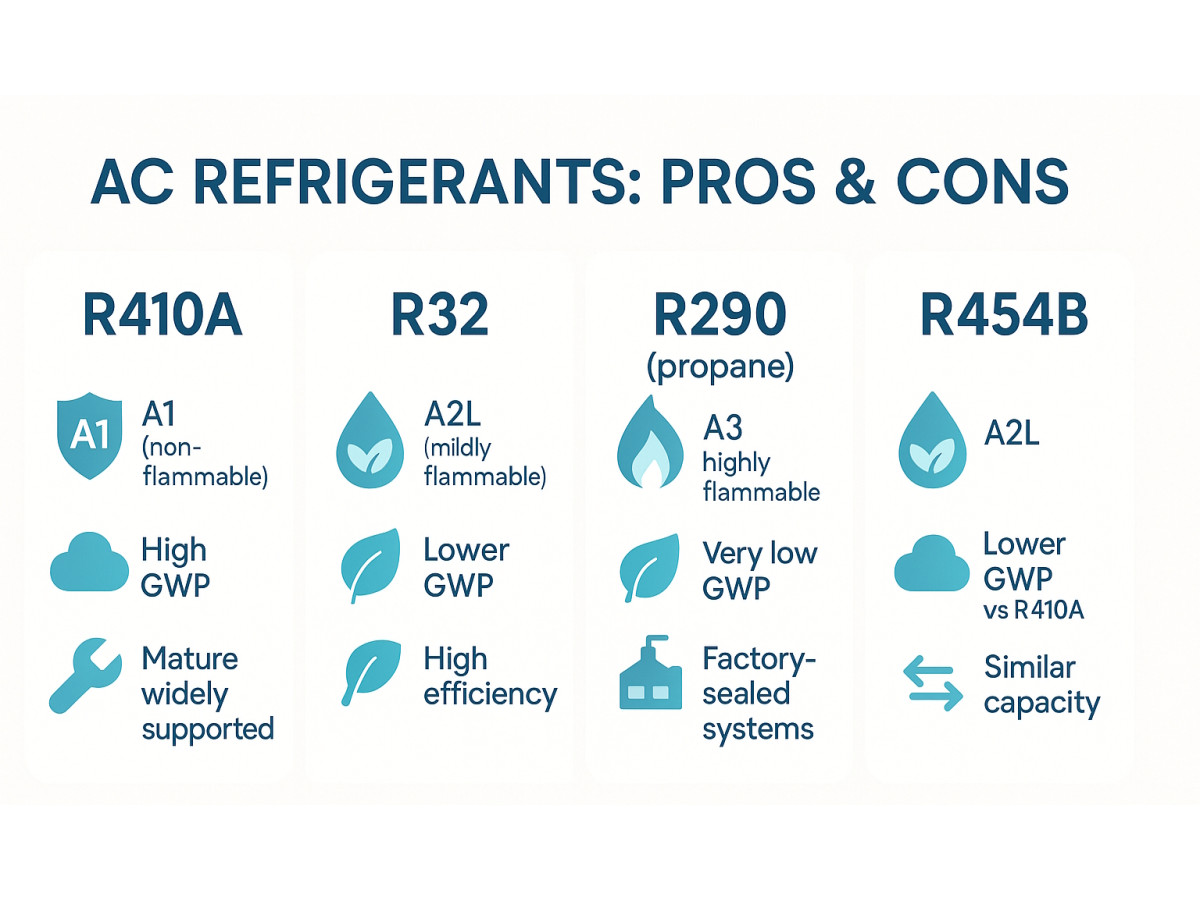
Pros and cons of different AC refrigerants
Quick context
Your choice of refrigerant affects efficiency, service needs, safety rules and climate impact. Charging and repairs must be done by licensed HVAC technicians.
Common options
R410A
-
Mature technology, predictable performance, wide service availability.
− High GWP and higher pressures; being phased down in new equipment.
R32
-
Strong seasonal efficiency, lower GWP, smaller charge per system.
− A2L (mildly flammable) — specific installation and ventilation requirements.
R290 (propane)
-
Very low GWP; excellent for modern heat pumps.
− A3 (highly flammable); factory-sealed units with strict charge limits only.
R454B / R452B
-
Lower GWP alternatives to R410A with comparable capacity/pressures.
− A2L classification; equipment compatibility and trained installers required.
R22 (legacy)
Discontinued in many markets due to environmental regulations.
How to choose
-
Compatibility: follow the unit nameplate — only the specified refrigerant.
-
Efficiency: R32 often leads on SEER/SCOP; A2L blends target R410A replacement with lower GWP.
-
Safety class: A1 vs A2L/A3 dictates handling and site rules.
-
Service & availability: ensure local supply and qualified support.
Compatibility: follow the unit nameplate — only the specified refrigerant.
Efficiency: R32 often leads on SEER/SCOP; A2L blends target R410A replacement with lower GWP.
Safety class: A1 vs A2L/A3 dictates handling and site rules.
Service & availability: ensure local supply and qualified support.
FAQ
Can I replace R410A with R32 by “just recharging”? No — different design and safety class.
Do sealed systems need top-ups? No; charge loss indicates a leak that must be fixed first.
Bottom line: For new splits, R32 or A2L blends are common; for installed units, stick to the specified refrigerant. Check Refrigerant-euro for compatible refrigerants and accessories.
If you're interested in choosing the right refrigerant for high-load warehouse systems, check out our article on R407C vs R22: technical comparison of eco-friendly refrigerants.
If you want to learn how low-GWP refrigerants can benefit your business, read our article on R134a refrigerant: everything you need to know about this popular refrigerant.