


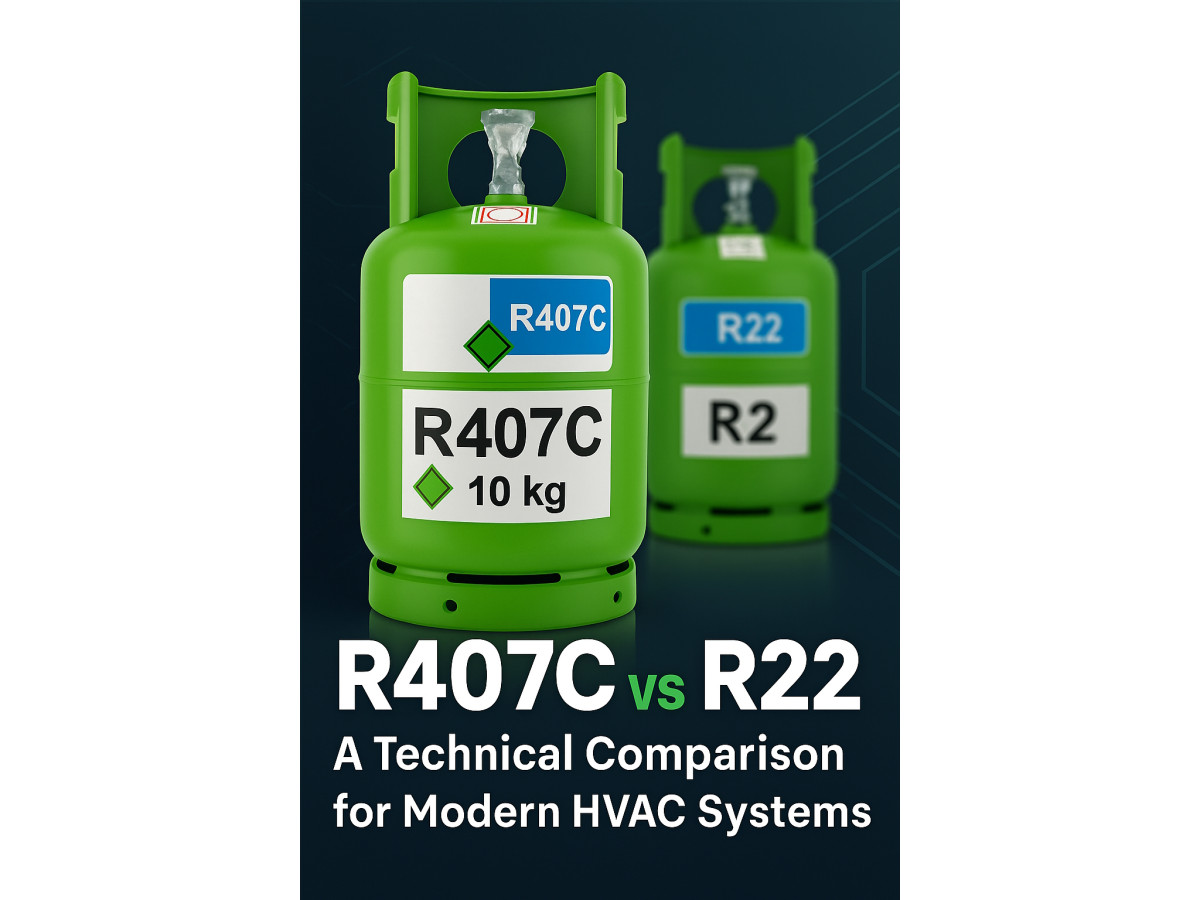
R407C can be considered for converting certain R22 installations, but it is not a refrigerant that can simply be added in place of R22. Similar operating characteristics do not establish compatibility with every compressor, lubricant or heat exchanger.
A successful conversion requires an assessment of the equipment, a suitable technical procedure and compliance with applicable regulations. Understanding the differences between R407C and R22 helps owners and service companies decide whether a retrofit is justified or equipment replacement is more appropriate.
R407C and R22: the main technical differences
| Property | R22 | R407C |
|---|---|---|
| Refrigerant type | Single-component HCFC | Zeotropic HFC blend |
| Composition | R22 | R32: 23%; R125: 25%; R134a: 52%, by mass |
| Ozone depletion potential, ODP | 0.055 | 0 |
| Phase change at constant pressure | One saturation temperature | A temperature range between bubble and dew points |
| Lubricant | Mineral, alkylbenzene or POE oil, depending on the compressor | Usually an approved POE oil; follow compressor specifications |
| Safety classification | A1 | A1 |
Class A1 indicates lower toxicity and no flame propagation under the specified classification tests. It does not mean that a refrigerant is harmless: pressure, oxygen displacement and cold burns from contact with liquid remain relevant hazards.
Why R407C is not a drop-in replacement for R22
Calling R407C a drop-in replacement suggests that the refrigerant can be changed without a proper compatibility assessment. In practice, an R22-to-R407C conversion is a retrofit: lubricant changes, component replacement and control adjustments may be necessary.
Before approving the work, the service company should establish:
- Whether the equipment and compressor manufacturers permit the proposed conversion.
- Whether the compressor remains within its permitted operating range.
- Which lubricant, viscosity and residual-oil limits apply.
- Whether seals, the expansion device, filter-drier and controls are suitable.
- What capacity, electrical load and operating temperatures can be expected after conversion.
Changing the oil and evacuating the circuit alone do not demonstrate that the installation is suitable. R407C must not be mixed with residual R22.
Temperature glide: how to use bubble and dew points
R407C is a zeotropic blend. At a given pressure, its liquid and vapour phases have different compositions, and evaporation or condensation occurs over a temperature range. This difference is called temperature glide.
The glide is several kelvin under many operating conditions, but it is not a fixed 7 K for every pressure and application. A single “boiling temperature” without a pressure and phase reference is therefore insufficient for service calculations.
- Bubble point: the saturated-liquid temperature, used to calculate liquid subcooling.
- Dew point: the saturated-vapour temperature, used to calculate vapour superheat.
Superheat = measured vapour temperature − dew-point temperature at the corresponding pressure.
Subcooling = bubble-point temperature at the corresponding pressure − measured liquid temperature.
For example, a measured vapour temperature of 10 °C and a dew-point temperature of 5 °C give 5 K of superheat. This illustrates the calculation; it is not a recommended setting for every system.
Use an R407C pressure-temperature table or a correctly configured instrument. Match pressure and temperature measurement locations, and check whether the pressure data are absolute or gauge values. A midpoint temperature must not replace the dew or bubble reference in these calculations.
Are pressures and cooling capacity the same as R22?
R407C was developed to provide characteristics close to R22 in selected applications. Nevertheless, pressure, cooling capacity, compressor power and discharge temperature depend on the actual operating conditions and equipment design.
There is no universal R407C working pressure, guaranteed energy saving or fixed capacity difference relative to R22. The permitted temperature range comes from the compressor and equipment documentation, not a general rule that evaporation must remain above −10 °C.
Systems with flooded evaporators require particular assessment. R407C's glide and potential composition changes make it unsuitable as an assumed standard retrofit for these designs.
Oil compatibility: why “use POE” is not enough
Many R22 systems contain mineral or alkylbenzene oil. These lubricants must not be assumed suitable for R407C, especially where reliable oil return depends on refrigerant-oil behaviour.
R407C installations commonly use polyolester oil, or POE. However, the compressor manufacturer must approve the oil type, viscosity and product specification. There is no universal number of oil changes or acceptable residual-mineral-oil percentage for every installation.
POE absorbs moisture readily. Cleanliness, limited exposure to ambient air and appropriate drying procedures matter. Flushing and filter-drier replacement should follow the approved conversion procedure and the assessed condition of the circuit.
Charging R407C and dealing with leaks
R407C should be withdrawn from the cylinder as liquid to preserve the intended blend composition. This does not mean allowing uncontrolled liquid flow into a running compressor. The charging method must follow the equipment instructions and prevent liquid slugging.
The required charge must be established for the converted system. Copying the original R22 charge by weight, or using one fixed percentage for every installation, is not a reliable rule.
A leak can alter blend composition, but the effect depends on the amount lost, the phase escaping and the operating conditions. It is incorrect to claim that every small leak necessarily makes the remaining R407C unusable.
After repairing the leak, topping up may be permitted by the applicable manufacturer instructions. Where composition is uncertain, contamination is suspected or performance cannot be restored, recovery and replacement of the full charge may be necessary. Repeatedly adding refrigerant without repairing the leak is not a solution.
For the diagnostic side of this work, see our guide to air-conditioning refrigerant leak diagnosis and repair.
Environmental impact and EU restrictions
R407C has zero ODP, but its GWP100 is approximately 1774 using the AR4-based HFC values applied under Regulation (EU) 2024/573. It is not a low-GWP refrigerant. Zero ozone depletion potential does not establish low climate impact or lower electricity consumption. Our explanation of refrigerant GWP and CO₂ equivalent covers this distinction.
R22 is an ozone-depleting substance covered by Regulation (EU) 2024/590. Ordinary charging and topping up with R22 are prohibited in the EU, including with recycled or reclaimed R22. Existing equipment and the refrigerant recovered from it must be handled under the applicable rules.
R407C is subject to F-gas requirements. Permission to service an existing installation does not establish permission to place new equipment using the same refrigerant on the market.
Long-term planning should also account for the restriction from 1 January 2032 on using Annex I gases with GWP of 750 or more to service stationary refrigeration equipment, excluding chillers. This includes virgin R407C; specified exceptions apply, including conditional use of reclaimed or recycled gas. This category-specific rule must not be treated as a general ban on servicing all air conditioners.
When does an R407C retrofit make sense?
A retrofit may be worth assessing when the equipment is in good condition, manufacturer support is available and the expected service life justifies the work. Extensive corrosion, repeated leaks, poor efficiency or unavailable components can make replacement more reasonable.
For installations already designed for R407C, or with a properly approved conversion, review the R407C 10 kg product page. Other products are listed in our refrigerant catalogue; their presence in the catalogue does not establish interchangeability.
Before ordering, confirm the equipment model, approved refrigerant, lubricant specification, required quantity and permitted use. After a conversion, the service documentation and equipment labelling should identify the new refrigerant and charge.
Write a comment