


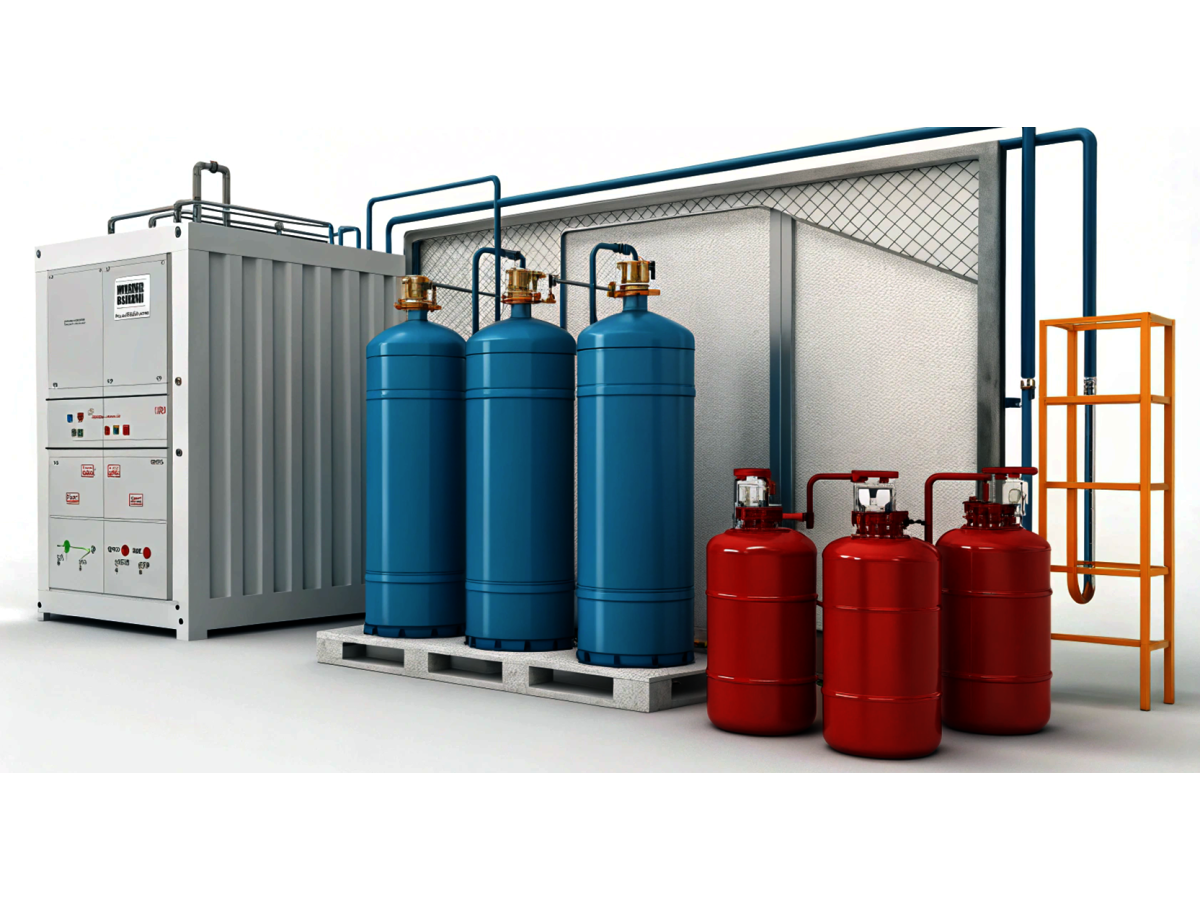
Choosing a refrigerant for industrial cooling affects temperature control, energy consumption, maintenance and the useful life of the installation. The right choice depends on the process, equipment design and applicable regulations. A refrigerant used successfully in one cold store or process chiller may be unsuitable for another system.
The first step is to establish whether you are servicing existing equipment, planning a retrofit or specifying a new installation. Each situation requires a different decision.
Existing equipment or a new industrial cooling system?
- Servicing an existing installation: identify the refrigerant specified on the nameplate and in the current technical documentation. Equipment age and cooling capacity alone do not determine which refrigerant can be used.
- Retrofitting a system: confirm that a documented conversion is technically feasible and permitted. A different refrigerant may require changes to components, lubricant, controls and operating settings.
- Designing a new installation: select the refrigerant together with the system architecture, operating conditions, safety provisions and maintenance strategy for its expected service life.
What operating data should you collect?
A useful specification describes the cooling duty and the conditions under which it must be delivered. Before comparing refrigerants or equipment, establish:
- The application: process cooling, chilled-water production, cold storage, freezing or another defined duty.
- The required temperatures: product or room temperature and, where relevant, the supply and return temperatures of water or glycol. These are different from the refrigerant's evaporating temperature.
- The cooling load: required capacity at normal and peak conditions, including changes during production cycles.
- The operating environment: outdoor temperature range, heat-rejection conditions, annual operating hours and part-load operation.
- The site requirements: installation location, access, ventilation, leak detection, available service expertise and acceptable downtime.
The design must also account for compressor operating limits, pressure ratings, lubricant compatibility and the materials used in the refrigerant circuit. A refrigerant's boiling point alone cannot establish its suitability.
Industrial refrigerants: applications and limitations
| Refrigerant | Typical applications | Main selection considerations |
|---|---|---|
| R134a | Existing chillers, process cooling and selected medium-temperature systems designed for R134a. | High GWP. Suitability depends on the equipment specification and the regulatory conditions for the intended application. |
| R407C | Compatible direct-expansion chillers and selected medium-temperature refrigeration systems. | A zeotropic blend with temperature glide. Compressor, heat-exchanger and control compatibility must be checked. |
| R404A | Existing medium- and low-temperature refrigeration installations. | High GWP and substantial EU restrictions. Servicing requires particular attention to the refrigerant's origin and permitted use. |
| R448A / R449A | Selected installations and approved conversions of certain R404A systems. | Lower GWP than R404A, but not universal replacements. Temperature glide, discharge temperature, controls and component compatibility require assessment. |
| R717 — ammonia | Purpose-designed industrial refrigeration, including food processing and cold storage. | Toxicity, flammability and material compatibility require appropriate engineering and qualified operation. |
| R744 — carbon dioxide | Purpose-designed cascade and transcritical refrigeration systems. | High operating and standstill pressures require suitable components and pressure management. Performance depends on system design and operating conditions. |
For new chillers, also evaluate the low-GWP solutions offered by equipment manufacturers, including suitable HFO refrigerants and blends. Their suitability depends on the specific machine, application and safety conditions.
Use the full refrigerant designation. R407C, R407A and R407F are different blends. Writing only “R407” in a specification or purchase order leaves the required product undefined.
GWP, ozone depletion and energy consumption
R134a is not a low-GWP refrigerant. Commonly used 100-year GWP values based on IPCC AR4 are 1430 for R134a, 1774 for R407C and 3922 for R404A. These refrigerants have zero ozone depletion potential, but their release still contributes to climate change. Zero ODP does not mean environmental harmlessness.
A complete environmental assessment considers refrigerant leakage, charge size, electricity consumption and refrigerant recovery at the end of the equipment's life. For statutory calculations, use the values and calculation method required by the applicable legislation.
EU restrictions that affect industrial refrigeration
Regulation (EU) 2024/573 distinguishes between servicing existing equipment and placing equipment on the market. The following milestones are particularly relevant; the exact equipment category and any applicable exemptions must also be checked.
Servicing equipment containing R404A
Since 1 January 2025, using virgin R404A to service refrigeration equipment has generally been prohibited in the EU because its GWP exceeds 2500. Specific exceptions include military equipment and applications designed to cool products below −50 °C.
Until 1 January 2030, qualifying reclaimed R404A may be used to service existing refrigeration equipment, subject to the required labelling. Recycled R404A is also subject to a time-limited exception, but it must have been recovered from refrigeration equipment and may only be used by the undertaking that carried out the recovery as part of servicing, or the undertaking for which that recovery was performed.
New chillers and future maintenance
From 1 January 2027, the EU restrictions on placing chillers on the market include a GWP threshold of 750 or more for rated capacities above 12 kW and 150 or more for capacities up to and including 12 kW. Site-specific safety exceptions and separately authorised exemptions have defined conditions. These limits are relevant when assessing new R134a or R407C chillers.
These market restrictions do not automatically require an already operating chiller to be shut down. However, commissioning equipment after the relevant deadline requires its eligibility to be checked and documented.
From 1 January 2032, additional servicing restrictions apply to Annex I gases with GWP of 750 or more in stationary refrigeration equipment, excluding chillers. The specified exceptions for reclaimed and recycled refrigerants do not override earlier, stricter restrictions.
Compare efficiency and retrofit costs
Request cooling capacity and electrical input data at the same operating conditions. For annual cost comparisons, include part-load performance, pumps, fans, defrosting and any useful heat recovery. Refrigerant choice alone does not guarantee a particular energy saving.
For an existing installation, compare the remaining equipment life, conversion work, expected electricity use, maintenance availability and downtime with the cost of replacement. A lower-GWP blend should only be selected after its compatibility and future legal use have been assessed.
Changing refrigerants requires a documented technical procedure. Flushing the circuit or changing the oil alone does not establish compatibility. Different refrigerants must not be mixed.
What to check before buying industrial refrigerant
- The equipment manufacturer, model and full refrigerant designation.
- The current charge specification and any documented retrofit history.
- The required net quantity and suitable cylinder or bulk packaging.
- The intended application and the regulatory conditions for purchase and use.
- The product label, supplier identification and batch traceability.
- The applicable safety data sheet and available quality documentation, including a batch certificate of analysis where provided.
- The qualifications required for the organisation carrying out the work.
If an existing installation specifies R134a and its intended use is permitted, review the R134a refrigerant in a 12 kg cylinder. For compatible equipment specified for R407C, see the R407C refrigerant in a 10 kg cylinder. Confirm the required charge from the equipment documentation; cylinder size does not determine the quantity the system needs.

Write a comment