


How to Properly Store and Transport Refrigerant Cylinders: Safety Guidelines
In the refrigeration and air-conditioning industry, refrigerant cylinders are often treated as routine consumables—purchased, transported, and used without much thought. In reality, however, they are pressurized containers, and improper handling can lead not only to financial losses, but also to serious safety risks for people and equipment.
This article explains how to correctly store and transport refrigerant cylinders, what checks should be carried out before use, and which rules must be followed within the European Union.
Why Safety Matters When Handling Refrigerants
Refrigerant inside a cylinder is stored under pressure, which increases as ambient temperature rises. This creates several common risk scenarios:
-
Overheating of the cylinder, for example when left in a closed vehicle exposed to sunlight;
-
Damage to the valve, the most vulnerable part of the cylinder, often caused by impacts during transport;
-
Gas release in enclosed spaces, where many refrigerants, being heavier than air, can accumulate and displace oxygen.
Even experienced technicians should never underestimate these risks. Basic safety rules are essential at every stage of handling.
What to Check Before Storage or Transport
Before placing a cylinder in storage or loading it into a vehicle, a brief inspection can prevent serious problems later.
1) Labeling and identification
Ensure that the label is clear and includes:
-
the refrigerant type (for example R134a, R410A, R32),
-
the net weight or volume,
-
the manufacturer’s information.
Using an incorrect refrigerant can cause severe damage to equipment. The consequences of such mistakes are explained in more detail in the blog article “What Happens If You Use the Wrong Refrigerant in Your Air Conditioner?”.
2) Valve and protective cap
-
The protective cap must always be in place.
-
The valve threads should be undamaged.
-
Oily residues or moisture around the valve may indicate a leak.
3) Cylinder condition
-
No deep dents or structural deformation;
-
No significant corrosion;
-
No visible signs of heavy impact.
4) “Empty” cylinders still require care
Even when a cylinder is considered empty, residual pressure may remain inside. It should therefore be handled with the same care as a full cylinder.
Proper Storage of Refrigerant Cylinders
Protection from heat and sunlight
Cylinders should be stored away from heat sources and direct sunlight. A common mistake is leaving them near windows or inside vehicles exposed to high temperatures.
Adequate ventilation
Storage areas must be well ventilated. Avoid small enclosed rooms, sealed closets, or spaces with poor air circulation.
Stable positioning
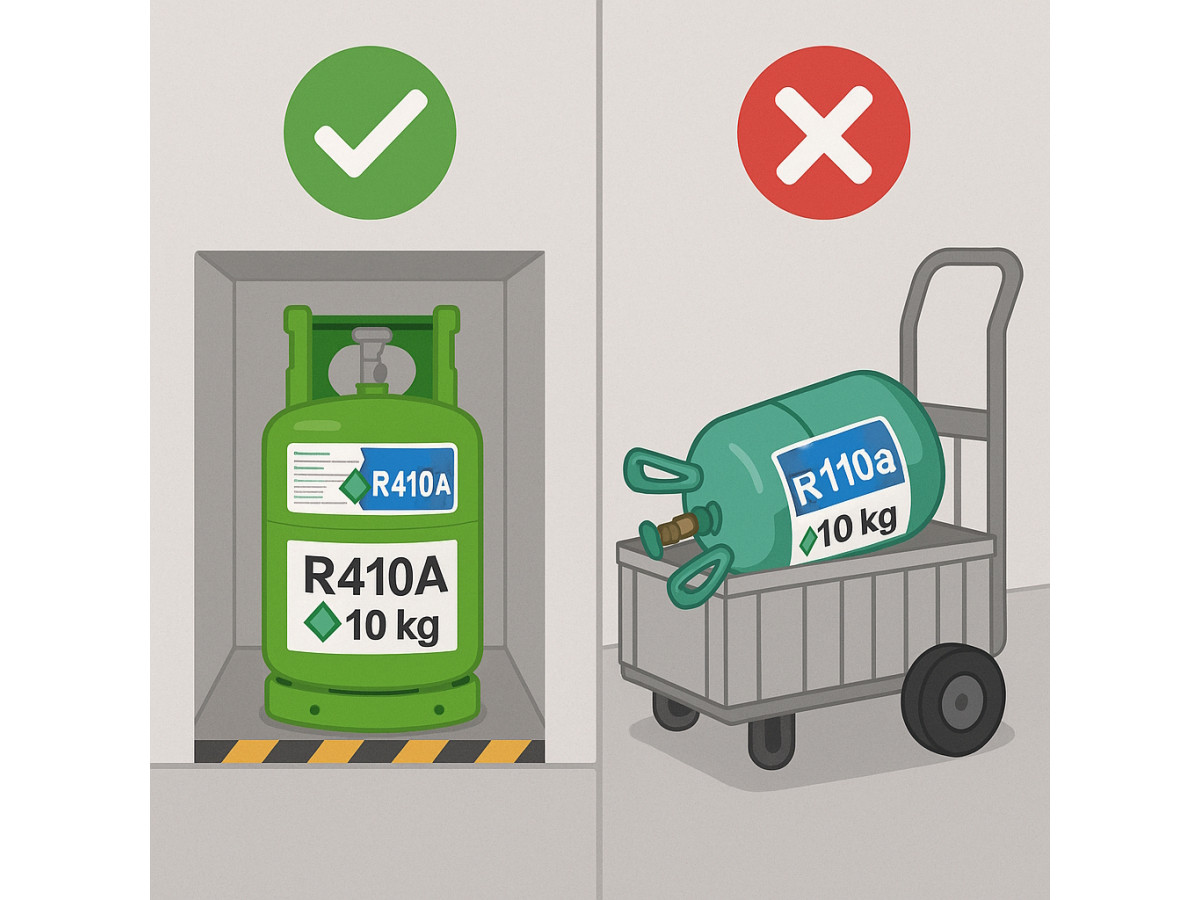
Cylinders should preferably be stored upright, on a flat surface, and secured to prevent tipping or falling.
Separation from hot work areas
Keep cylinders away from welding, grinding, and other activities that generate heat or sparks.
Routine inspection
Before use or dispatch, always check the cylinder and valve for signs of damage or leakage.
Safe Transportation of Refrigerant Cylinders
Transportation is one of the most critical phases of cylinder handling.
-
Cylinders must be securely fastened so they cannot roll or move during transit.
-
Transport them in a cargo area or trunk, not in the passenger compartment.
-
Never leave cylinders in a hot, closed vehicle, even for a short time.
-
Whenever possible, transport cylinders in an upright position.
-
During loading and unloading, never lift a cylinder by the valve or protective cap.
Within the European Union: Ban on Disposable Refrigerant Cylinders
When operating within the European Union, it is essential to comply with environmental legislation. The use and placing on the market of disposable (non-refillable) refrigerant cylinders containing fluorinated gases is prohibited within the EU when intended for servicing, maintenance, and refilling of refrigeration and air-conditioning systems.
These restrictions are part of the EU F-gas regulation and aim to:
-
reduce greenhouse gas emissions,
-
prevent uncontrolled refrigerant leakage,
-
promote safer and more sustainable practices.
In practice, this means that only refillable refrigerant cylinders may be used, and refrigerants must be sourced from suppliers that comply with EU legislation.
To better understand the environmental impact of refrigerants and the importance of the GWP value, see the blog article “What Is GWP and Why It Matters When Choosing a Refrigerant”.
Personal Protective Equipment and Leak Response
When handling refrigerant cylinders, it is recommended to use:
-
protective gloves,
-
safety goggles,
-
adequate ventilation in the working area.
If a leak is suspected:
-
stop work immediately;
-
ventilate the area;
-
keep people away from the affected zone;
-
avoid open flames;
-
if symptoms occur, move to fresh air and seek medical advice.
Common Mistakes to Avoid
-
transporting cylinders without securing them;
-
storing cylinders near heat sources;
-
removing the protective valve cap;
-
lifting cylinders by the valve;
-
storing empty cylinders in poorly ventilated areas.
Frequently Asked Questions (FAQ)
Can refrigerant cylinders be stored on a balcony?
Only if they are protected from direct sunlight and the area is well ventilated.
Is an empty cylinder safe?
Not always. Residual pressure often remains inside.
Is horizontal transport allowed?
In some cases, yes-but only if the cylinder is fully immobilized.
Why is the valve so critical?
Because damage to the valve can cause sudden and uncontrolled leakage.
What is more dangerous: heat or impact?
Both pose significant risks and often occur together.
Conclusion
Safe storage and transport of refrigerant cylinders rely on simple but essential principles: protection from heat, good ventilation, stable positioning, and secure fastening during transport. Following these guidelines helps prevent accidents, protect equipment, and ensure compliance with regulations across the European Union.