


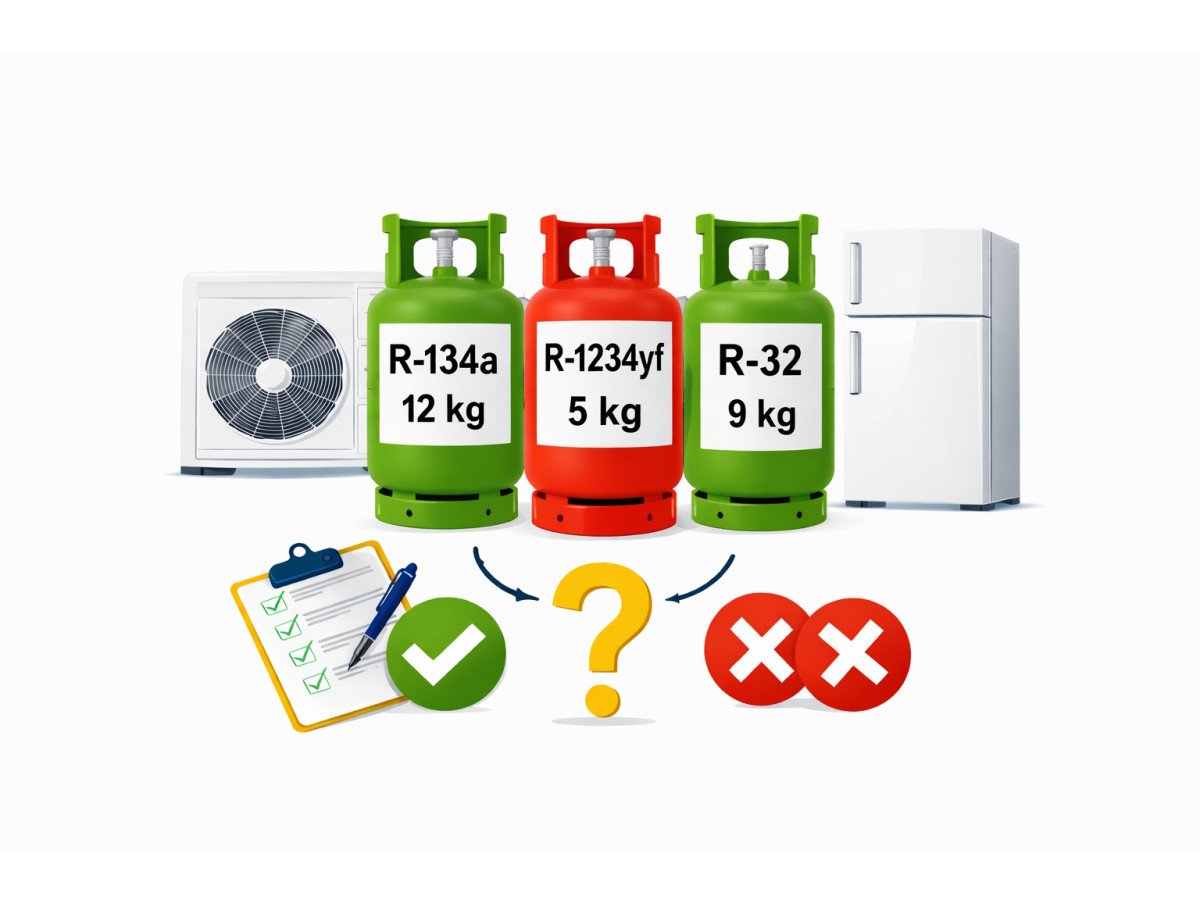
How to Choose the Right Refrigerant for Air Conditioning and Refrigeration Equipment
To purchase a refrigerant without risks or negative consequences for your equipment, it is essential to follow the information stated on the manufacturer’s nameplate, verify oil compatibility, select the correct cylinder type, and prepare the necessary tools in advance: charging scales, a manifold gauge set, a vacuum pump, and suitable adapters.
Choosing a refrigerant based strictly on the factory specifications is the most reliable way to achieve stable cooling or heating performance, proper efficiency, and long compressor service life.
An incorrectly selected refrigerant does not simply result in weak cooling. It leads to higher system load, overheating, noise, reduced efficiency, and a real risk of expensive repairs. In practice, most issues arise during the selection stage-not during charging.
What to Check Before Buying Refrigerant
Before purchasing refrigerant-whether retail or wholesale-it is important to review several essential points. Ignoring them often leads to situations like “it doesn’t fit,” “the system works worse,” or “the refrigerant leaked out again.
1) Refrigerant Type
The equipment nameplate always specifies the exact refrigerant type, such as R134a, R410A, R32, or R404A.
The refrigerant must be selected strictly according to this specification.
Not a “similar option,” not an “alternative,” and not “what was used last time.”
If the system is designed for R410A, using R32 as a replacement without clear manufacturer approval and full understanding of system requirements is a mistake. Even newer and more environmentally friendly refrigerants require equipment specifically designed for them.
Those who want to better understand the consequences of incorrect selection can refer to a dedicated blog article explaining what happens when the wrong refrigerant is used in an air conditioning system.
2) Equipment Type
Refrigerant selection depends not only on the code, but also on how and where the system operates:
-
air conditioners and split systems
-
household refrigerators and freezers
-
heat pumps
-
automotive air conditioning
-
commercial and industrial refrigeration systems
The same refrigerant may work properly in one application and be completely unsuitable in another due to differences in pressure levels, oils, and service requirements.
3) Oil Compatibility
One of the most common-and costly-mistakes is ignoring oil compatibility.
Refrigeration systems use different lubricants, including:
-
POE oils
-
PAG oils
-
mineral oils (MO)
These oils are not interchangeable. Even refrigerants with similar characteristics may be incompatible with the existing oil, resulting in reduced efficiency, noisy operation, overheating, and accelerated compressor wear.
4) Purchase Format
Before buying refrigerant, check:
-
whether the cylinder is disposable or refillable,
-
the refrigerant weight or volume,
-
valve type and compatibility with your manifold and adapters.
A common issue is having the refrigerant on hand but being unable to connect it to the system without additional fittings.
5) Tools and Accessories
To avoid interruptions during service, make sure you have:
-
proper valves and adapters,
-
charging scales (mandatory for accurate filling),
-
a manifold gauge set,
-
a vacuum pump,
-
leak detection tools if required.
Refrigerant alone is not a solution without the correct equipment.
6) Leak Inspection
If the system has a leak, simply topping up refrigerant provides only a temporary effect. The correct approach is to locate and repair the leak first, then recharge the system properly.
How to Choose Refrigerant for Your Equipment
The most reliable reference point is the label on the outdoor unit, compressor, or technical nameplate.
Quick guidance:
-
R410A - high operating pressure, specific fittings, widely used in split systems
-
R32 - modern and efficient, but with additional safety and service requirements
-
R134a - commonly used in automotive air conditioning and some household appliances
Even visually identical units may be designed for different pressures and oils. Choosing refrigerant “by similarity” is the highest-risk approach.
Refrigerant Charging: What Really Matters
Can You Simply “Top Up” Refrigerant?
Only after confirming the system is fully sealed.
Otherwise, you are repeatedly “feeding” the same problem.
Correct Service Sequence
-
leak diagnosis
-
fault repair
-
vacuum evacuation
-
charging strictly by weight
-
pressure and performance checks
Charging “by feel” reduces efficiency and significantly shortens compressor lifespan.
The importance of regular inspections and proper maintenance is discussed in more detail in a blog article focused on how often refrigerant levels should be checked and why routine servicing matters.
How to Recognize a Refrigerant Leak
Common signs include:
-
reduced cooling performance,
-
longer compressor operating cycles,
-
oily residue on connections,
-
icing on the evaporator or refrigerant lines.
The correct solution is leak repair-not repeated recharging.
Legal and Regulatory Considerations in the EU
Within the European Union, regulations governing fluorinated gases affect refrigerant availability, promote lower-GWP options, and impose specific service and documentation requirements.
It is important to remember that a more “environmentally friendly” refrigerant is not automatically compatible with your existing system.
Conclusion
Choosing the correct refrigerant follows a clear and disciplined process:
equipment label → oil compatibility → leak inspection and repair → vacuum evacuation → charging by weight → operational verification.
This approach ensures stable performance, quiet operation, and long compressor life. Preparing refrigerant together with the necessary tools and accessories also helps avoid downtime and unnecessary service delays.