


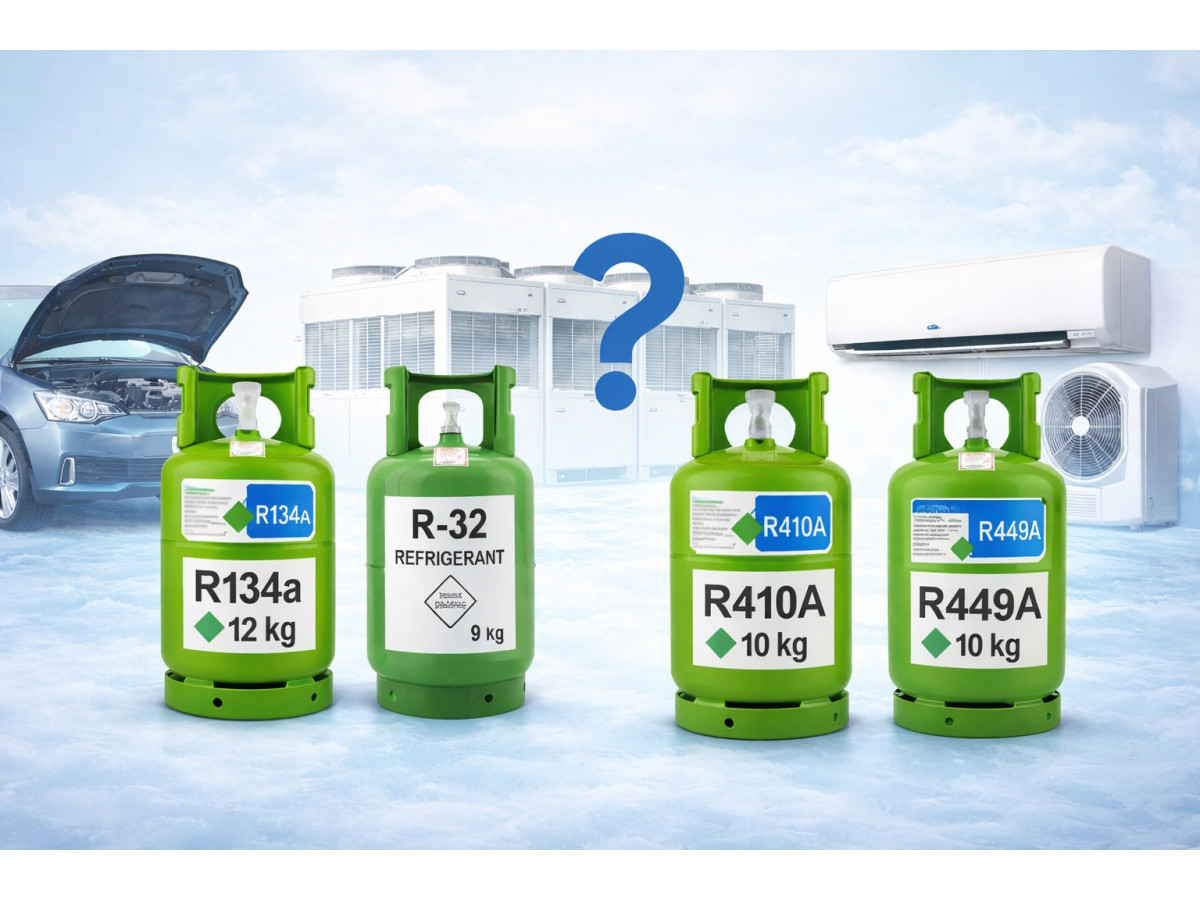
Can the Same Refrigerant Be Used for Different Types of Equipment? Myths vs Reality
Introduction
In the HVAC and refrigeration industry, one question comes up again and again: can the same refrigerant be used across different types of equipment? At first glance, the idea sounds reasonable. After all, a refrigerant’s main job is to absorb and release heat - so why wouldn’t one solution fit all?
In reality, using the wrong refrigerant is one of the most common causes of reduced efficiency and premature equipment failure. Many of these misunderstandings are rooted in outdated assumptions, which are also discussed in “Top 5 Refrigerant Myths Every Air Conditioner Owner Should Know”. Let’s take a closer look at what actually works — and what doesn’t.
What Is a Refrigerant and Why It’s Not Universal
A refrigerant is the working fluid that circulates inside a cooling or air conditioning system, enabling heat transfer. Each refrigerant is engineered with specific physical and chemical properties that determine where and how it can be used.
Key characteristics include operating pressure, boiling point, oil compatibility, safety classification, and environmental impact. Because these parameters vary widely, no single refrigerant can perform efficiently in every type of system.
Why the “One Refrigerant Fits All” Idea Is Misleading
A common misconception is that if a refrigerant works well in one system, it should work just as well in another. However, HVAC and refrigeration equipment is designed around very precise operating conditions.
Compressors are built for specific pressure ranges, heat exchangers are optimized for certain temperature differences, and expansion devices are calibrated for defined flow characteristics. Introducing an incompatible refrigerant can lead to unstable operation, overheating, and accelerated wear of critical components.
Can the Same Refrigerant Be Used in Refrigerators and Air Conditioners?
Although refrigerators and air conditioners rely on similar thermodynamic principles, their operating environments are very different. Household refrigerators typically run continuously to maintain a stable internal temperature, while air conditioners operate in cycles and respond to fluctuating heat loads.
Using a refrigerant designed for air conditioning in a refrigeration system - or vice versa - can result in poor cooling performance and long-term reliability issues. The technical consequences of such decisions are explained in more detail in “What Happens If You Use the Wrong Refrigerant in Your Air Conditioner?”.
When the Same Refrigerant Is Used Across Different Systems
There are limited scenarios where a single refrigerant is approved for use in multiple types of equipment. This is most common in commercial refrigeration, heat pump systems, and certain industrial applications.
Even in these cases, manufacturers clearly specify which models and operating conditions are acceptable. Replacing a refrigerant without proper system evaluation is never recommended and may void warranties or violate safety regulations.
Common Refrigerants and Their Typical Applications
R134a is widely used in refrigeration systems and chillers. In some cases, it may be applied in other equipment, but only when the system is explicitly designed for it.
R404A is primarily found in low-temperature applications such as freezers. Due to its operating characteristics, it is generally unsuitable for other types of systems.
R410A is designed for modern air conditioning units and cannot be used in systems built for different refrigerants.
R407C is commonly used in heat pumps and selected HVAC installations. It may serve as an alternative in certain cases, but only after confirming technical compatibility.
R600a is intended for domestic refrigerators and is not used in air conditioning or commercial refrigeration equipment.
Frequently Asked Questions
Can I recharge an air conditioner with a different refrigerant?
No. Even refrigerants with similar properties can disrupt system performance and cause damage.
Is there a truly universal refrigerant?
At present, no refrigerant is suitable for all types of cooling and HVAC equipment.
Why is refrigerant pressure so important?
Because system components are engineered to operate safely within specific pressure limits.
How to Choose the Right Refrigerant
To avoid costly mistakes, always:
-
check the equipment nameplate;
-
review the manufacturer’s technical documentation;
-
confirm compressor oil compatibility;
-
avoid choosing based solely on “similar” specifications;
-
consult qualified HVAC professionals when in doubt.
Conclusion
Using the same refrigerant for different types of equipment is the exception, not the rule. Attempts to simplify refrigerant selection often lead to higher operating costs and unexpected repairs.
Choosing the correct refrigerant ensures stable operation, optimal energy efficiency, and a longer service life for your equipment. When uncertainty arises, informed decisions always outperform risky shortcuts.