


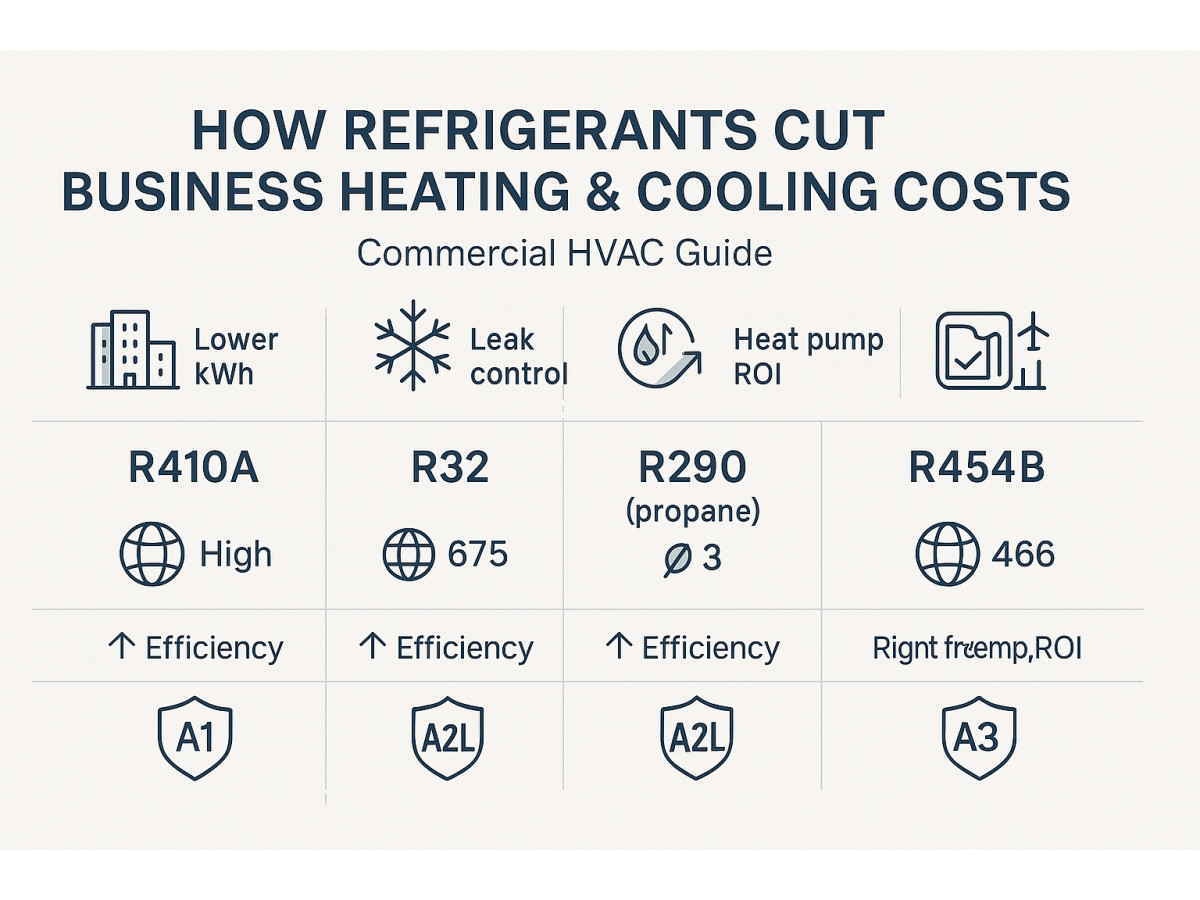
How refrigerants save money
A refrigerant is the heat carrier. Used in equipment designed for it—and maintained properly—it raises SEER/SCOP/COP and lowers electricity and service spend.
1) Pick the right refrigerant for the job
-
R32 often achieves higher seasonal efficiency than R410A with a smaller charge.
-
R454B/R452B: lower-GWP replacements in new units with familiar capacity/pressures.
-
R290 (propane): very efficient in factory-sealed heat pumps (A3 safety rules).
-
R410A: still economical to keep in healthy existing systems thanks to broad service support.
Never “recharge” a unit with a refrigerant not on the nameplate. Efficiency, safety and compliance will suffer.
2) Heat pumps as heating cost savers
For shoulder seasons and mild winters, a heat pump on R32 (or approved R290 units) can replace resistive heaters and cut cost per kWh of heat dramatically—common quick wins for offices, retail and hotels.
3) Maintenance: leaks are silent bill-raisers
Charge loss skews superheat/subcooling, extends compressor runtime and spikes kWh.
Watch for: frost on service valves, oily spots, reduced capacity.
Fix: locate leak, repair, evacuate, charge by weight, verify filter-drier, clean coils.
4) Controls & optimization that pay back fast
-
Setpoints & schedules: night setback, staged start, occupancy control.
-
Clean heat exchangers & filters: lower ΔT → lower fan/pump power.
-
TXV/EEV tuning: correct superheat; avoid excessive subcooling.
-
Heat recovery: in VRF/chillers, reuse waste heat for DHW or adjacent zones.
5) Retrofit or replace?
-
Keep a tight R410A system if efficient and reliable.
-
If equipment is old/inefficient, a new A2L unit (e.g., R32 or R454B) can repay in 2–4 seasons via lower energy and fewer callouts (site-specific).
Quick cost sketch
A 900 m² office uses ~28,000 kWh/season for cooling with an older unit. Upgrading to R32 with ~18–22% better SEER can save 5,000–6,000 kWh. At €0.15/kWh that’s €750–900/season, plus reduced maintenance from cleaner coils and correct charge.
Action checklist
-
Use only the refrigerant specified on the nameplate.
-
Leak test annually; log charge by weight.
-
Keep coils/filters clean; verify superheat/subcooling.
-
Optimize schedules and setpoints.
-
Consider a heat pump for heating duty where feasible.
Bottom line: the “right refrigerant + right maintenance” equation turns into real money. Refrigerant-euro can match the correct refrigerant, oil, fittings and leak-detection tools for your model and regulations.
If you want to learn how refrigerants can reduce heating and cooling costs, check out our article on R-32 refrigerant and its impact on energy consumption in air conditioners.
If you're interested in which refrigerants are suitable for both old and new systems, read our article on the advantages and disadvantages of different types of refrigerants for air conditioners.